City of Clearwater Commission Hearing: The Church of ScientologyDay 4, Scott Mayer more
|
|
The next witness is Scott Mayer.
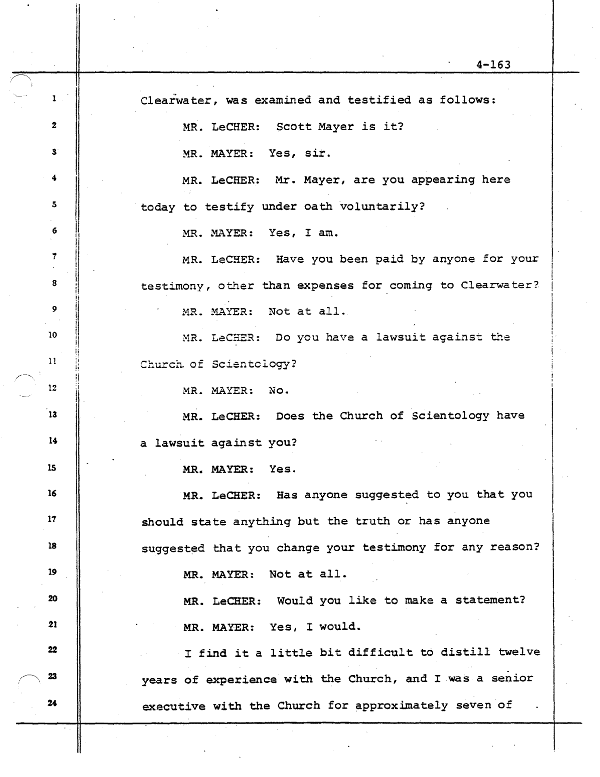
SCOTT MAYER, a witness herein, having first been duly sworn by a Clerk for the City of Clearwater, was examined and testified as follows: MR. LeCHER: Scott Mayer is it? MR. MAYER: Yes, sir. MR. LeCHER: Mr. Mayer, are you appearing here today to testify under oath voluntarily? MR. MAYER: Yes, I am. MR. LeCHER: Have you been paid by anyone for your testimony, other than expenses for coming to Clearwater? MR. MAYER: Not at all. MR. LeCHER: Do you have a lawsuit against the Church of Scientology? MR. MAYER: No. MR. LeCHER: Does the Church of Scientology have a lawsuit against you? MR. MAYER: Yes. MR. LeCHER: Has anyone suggested to you that you that you should state anything but the truth or has anyone suggested that you change your testimony for any reason? MR. MAYER: Not at all. MR. LeCHER: Would you like to make a statement? MR. MAYER: Yes, I would. I find it a little bit difficult to distill twelve years of experience with the Church, and I was a senior executive with the Church for approximately seven of those years. So, to distill all of that information into a small period of time is kind of difficult. So, I prepared an outline of things that I would like to touch on and — in kind of a rapid sequence — and after that's through, I'm willing to answer questions about any of these areas I touch on, if that's agreeable to you. MR. LeCHER: Yes, sir. Why don't you just follow your outline and we can ask you questions when you complete your outline. MR. MAYER: All right. I, basically, just wanted to let you know what I was doing. I worked on an on-call basis as a legal assistant and an administrative assistant for the City of Santa Monica in the City Attorney's Office and the Environmental Services area, and I worked for — also, as a consultant to the Internal Revenue Service in the U.S. tax case that's been going on for some time now. And I worked with the senior counselor for the IRS during that tax case as consultant. The tax case I'm referring to is the time period 1968 through '71 in the U.S. Tax Court, Judge Sterrit presiding. It's the Church of Scientology against the Internal Revenue Service. In terms of getting into the Sea Organization, I entered the Sea Organization as a result of having a ship's master training program being offered to me. At one time, during the Viet Nam War, I was on a navigation team flagship in the Seventh Fleet and used to run aircraft carriers in and out of various harbors around the world, so I had quite a bit of ship experience when I was first exposed to Scientology. And I was offered a training program that would get me a master's certificate, and I went in on that basis, that and an educational program. What I want to do real quickly here is just give you some sort of a background on what I did because I went all over the world for the Church for a long time, and, basically, on a trouble-shooting basis. And the main point that I think I really want to stress here — bring out from an insider's point of view — is the overall administrative structure of the Church. There's a great deal of publicity that's put out that your individual churches are corporate bodies unto themselves with their own board of directors. And many of the boards of directors are on the planet that they publicize, and I worked with those directors. And they were just common, everyday staff members who signed papers when it was necessary. So, I want to kind of go over the post areas that I've held in my job so that you can see what kind of a background I had. And it will probably make it a little bit easier for you to ask direct questions later. I have been at one time or another everything from a bodyguard to the now deceased Quentin Hubbard to the fleet captain for the Hubbard cruiseships on the west coast; I was an executive trouble-shooter for top management of the Church; I went on a few missions out of Clearwater under control of the Church of Scientology; and as an administrative director, in other words, as a command team. The basic command of the organization, for the entire Church of Scientology, when I left in 1966, was situated right here — MRS. GARVEY : '76. MR. MAYER: — excuse me — was situated here in Clearwater, and had been on the Flagship Apollo. I was the ship's manager just prior to the move here, and part of my job was getting the ship ready to come in here. I did approximately eighteen successful missions for the senior top management of the Church all over the world, including South Africa, Scotland, Manchester, Saint Hill in England. I worked with Guardian's Office staff members. I worked with Jane Kember; I worked with Mo Budlong. I did an intelligence mission in Scotland for the Church while I was there. Jane Kember was the Guardian for the Church of Scientology, the head of the Guardian's Office below Mary Sue Hubbard. Mary Sue Hubbard was Commodore's Staff Guardian, which the Commodore's Staff were the assistants to the Commodore, to Ron, in each of the divisional areas of the Church: finance, dissemination, public relations. Ron had a staff member, Commodore's Staff, for each one of those areas. Here in Clearwater, they did evaluations on a weekly basis for the entire worldwide network of the Church. On the basis of the financial well-being of the various organizations around the world, missions — people who were top-management trained — would go out to various organizations to back the income back up if it was down. And your whole control or command information center for those evaluations centered in Tampa after they moved here and then Flag was moved into the Fort Harrison Hotel. So, that's just a little kind of a background on the type of thing I did. I acted, primarily, as a trouble-shooter, and as things were going on, I was sent out. The reason I left Scientology, by the way, was because of the things that I saw and participated in through my tenure with the Church. It got to the point where I could no longer in my own mind justify what the Church's policy in handling government agencies and society was; they were allegedly there to save. I could no longer reconcile that with the stated aims of the Church. So, I resigned from the Sea Organization while on leave of absence in 1976, and I was subsequently expelled from the Church. Part of the reason I wanted to come down here is that I had talked to Martin Cohen, who's the senior counselor for the IRS in the tax case, about a week or so ago. And I asked him if there was anything that I could, you know, do for them while I was down there in terms of bringing back information. One of the things that he said to me is "You know, Scott, you've been a year at this now" — and I'm still on an on-call basis as a consultant. He said, "If I had realized what you were trying to tell me a year ago, we could have had a whole different tack in this case." And I have a — and I have to admit to you that I've stayed pretty well in hiding for the last three years, after I had an experience when my car was blown up on Christmas Eve in 1978 in front of a place where the Church thought I was staying, but I was living elsewhere. I had planted that information with the Church so that I'd know if they were trying to contact me. So, I've stayed pretty much in hiding. And I feel that these hearings are a chance for a little bit of light to come out on this so that people who are out in the field now — and I know a lot of them. I'm small potatoes compared to what some others out in the field have done, things that they've done and experienced. And I would like very much for them to feel free to be able to rejoin society and contribute to it, because that, in essence, was their main concern and reason for going into the Church in the first place: it was to help evolve the planet. There's a tendency to kind of group Scientologists together in terms of the reflection that the top management presented, but the average staff member is nothing more, as far as I'm concerned, than a psychological — a psychopolitical dupe. The organization is structured in such a manner that everything is done on a neat basis, much like security in the military. So, all those — and evaluations are done to keep various areas of the Church from operating on their own goals and purposes without really knowing what's going on in another area, although, there is an incredible grapevine that goes through the Church of Scientology. And I had an amusing incident about a week ago where I told a story to someone who was no longer in Scientology at a place in Los Angeles, California, and within a week, the story had gone across country through some Scientologists and back through my wife's — a friend of my wife's and back to me. And the person that I talked to could no longer get any information about the Church. But it took a week, just person-to-person, to get the story. I won't bother with the story. Getting back to my original point: I'm, basically, here today to try to impress you with the magnitude of the operation that you are facing. And I want you to know in no uncertain terms that there is constant evaluation of this hearing going on and all of the things that have happened up to now. And right over here in the Combat Information Center — if that's where they've still got it — evaluations are being done on how to handle you. And I would like to see the tables turned for a change, because I don't think that they're going to be successful. The points that I would like to cover today are, basically: violations of clear cut — of policy, such as registration and operation of maritime vessels, violations of those rules; transportation of funds in and out of the United States illegally; the violation of Federal Communications Regulations on the use of telex and radio communication equipment; transportation of personnel into and out of the country in violation of immigration laws; conspiracy to impede the IRS; the use of cruel and unusual punishment; and the attempt to defraud the United States Postal Service. And I have personal experience with the Church in all of those areas. Also, the ill treatment of children, parishioners; living conditions — I've travelled to almost all the organizations around the world, and Clearwater is just another step in the whole game. In accounting, you know, you talk about the normal course of business and business papers, things that are written out and done standardly pretty much on a day-to-day basis, and you don't deviate. Well, the Church has a standard operating basis, and it has an incredible amount of policy that it can show you to tell you that it's not doing anything, but to someone who's really well trained in the policy, they can show you policy that makes it be all right. So, you continuously have a facade being put forth to the public about what's Church policy, but there is corollary — corresponding policy that would make it all right to violate that policy. MR. CALDERBANK: Superseding policy? MR. MAYER: Yes. Well, it happens to be a crime in the Church to impede Scientology. And any staff member, you know, is severely punished in terms of the organization for impeding the progress or the expansion of Scientology. That's called High Crime Policy; the Fair Game Policy is part of that, which is allegedly cancelled, but I have never found a Church official that could show me the policy that cancelled it because it would have to be written by L. Ron Hubbard and, you know, specifically deny that policy, not a little caption printed down at the bottom. I printed those captions; I used to be Deputy Post Chief US in the early seventies. We put them on all the policy letters, which didn't cancel anything, certainly not the way an Ethics Officer would handle a person who's trying to impede the progress of the Church. In terms of the Fair Game Policy itself, of course, I have no way of proving that the Church of Scientology blew up my car. I just have the knowledge within myself that that's where I told them I was and that's where it got blown up. The fact that I didn't live there was to my credit, not theirs. In testifying before the U.S. Tax Court, the day after my address went on the record, I was sued by the Church by my ex-wife, who, I assume, is still in Scientology. The transcript hadn't even been published yet and they had my name and address and had a little kid come out and serve me papers. So, I was being sued, and I subsequently moved. I was under IRS protection at the time, anyway; they stayed at the house. So, I moved and I've been moving ever since. They also pulled out my — what's called a B 1 File, during the Scientology hearings. And what it basically is is a list of the things that I have done wrong in the past that came out of my confessional folder. I'm kind of getting a little out of sequence here in terms of what I wanted to talk to you about, but since the point has been brought out, there is a statement by the Church that confessional folders are not available to anybody but the auditor or the minister. And I can't tell you the number of folders that I looked at when I was going around in various organizations trying to get the income up, because I had to know what was going on with them in order to get them back on line and get them doing their job. So, they brought out my B 1 File. I didn't even know it was that thick; I was rather flattered. I didn't know they could get that much stuff out of it. And there were a couple of files sitting right next to me with — in the courtroom that had my name on it, and they didn't have anything but my confessional folders and my B 1 File. The B 1 File comes out of the confessional folder. It's a time sequence — day/time sequence — list of all of the things they feel they can use. That's a very good point. This was during the second day of the trial in Los Angeles, California that the files appeared. MR. LeCHER: Which trial is that? MR. MAYER: This is the U.S. Tax Court trial. The approximate time would have been around February of last year; it was about February of last year. I was — about two days into it — you have to realize that my function during the trial was — when a Scientologist would get up on the stand and tell their version of what was going on in the Church, whenever they would either directly lie or when they would present a policy letter that was supposed to tell what kind of — what their policy was on the subject that was being discussed, I would reach over to Mr. Cohen and I would direct him to the policy letter, the definitions that opposed that. So, I was not very popular with the Church's attorney, because we were shooting holes in their stories. For the next couple of days, my folders arrived. And it was just nothing more than the standard attempt to intimidate me and let me know that they were going to try to make public what was in my confessional folders. Well, I would willingly let any one of you read them now, because there isn't anything that anybody's going to do to me anyway. I did what I did; I've been what I've been, and I've either learned from it or I haven't. So, I don't have any secrets that way. But it was an attempt to intimidate — MR. LeCHER: Was that about when your car was blown up? MR. MAYER: No. That was 1978, and I had been moving around. In addition, several Guardian's Office members appeared at friends of mine's houses looking for me during the trial. In fact, the day before I was supposed to appear, I got a telephone call from a Karen Kyper, who had — was originally out of the Minneapolis Organization and married to Bob Kyper, also a Guardian's Office staff member. She and another girl harassed a friend of mine down at Laguna Beach; they were trying to get in touch with me before I went in and testified. The other areas that I would like to cover with you, is how Scientology actually operates against the best interests of the community and, possibly, touch on some things that I think would help you in the incredible job you've got of making ordinances out of all this. So, I'd like to get back to the use of various telex equipment and so on and so forth. During the course of my time in Scientology, as senior executive, I was on call twenty-four hours a day. I could be on course in Los Angeles and be ordered into briefing because a set of Flag Mission Orders had come in, ordering me to Austin, Texas or Boston or Florida or South Africa. And I'd have about fifteen or twenty minutes to get my stuff together and get into briefing. And, incidentally, one of my jobs when I first got into the upper level of the executive structure was briefing couriers on how to get things in and out of the country. I'm — I probably have a hundred briefing tapes of people, couriers, that I briefed on how to-get through the various immigration and customs officials, postal officials, attempts to get things out of the country. I have been personally involved with people who have brought money in and out of the United States. |
 |
|
|
My ex-wife and I smuggled two thousand dollars worth of rand apiece into this — into Clearwater on our last
mission from South Africa in 1976.
MR. LeCHER: Two thousand dollars worth of what? MR. MAYER: Rand, krugerand — MR. LeCHER: Oh. MR. MAYER: — that's the name of the currency there. So, I'm familiar with the fact that it isn't just an accident that some money gets out of the country. It's a regular, established procedure. There' s an interesting thing about the procedure, too, because on the — on the face of it it looks like everyday business activities and students coming in and out and so on and so forth. It's just exactly what it's supposed to look like. A Scientologist, for instance, in Los Angeles who was going to come to Clearwater to get some training would be taken into the briefing room in Los Angeles and briefed on techniques of getting through various government agencies. They would even go so far as to clay demo; they would do clay demonstrations of the ways they were going to do it: what if this happened. And I would grill them on all the possibility — all the things that I thought that they could run into, until I was certain that they could pass a security check, which is nothing more than a lie detector test. And they could go down and they could say that they understood their mission and they knew how to carry it out, and they had no other reason for going than to carry the mission out. This was routine. They were routinely checked on a lie detector to make sure they actually got what I was trying to tell them and, you know, didn't have any other reasons for doing it. We might send out twelve or fifteen people in a week to Clearwater and to other places earlier where Flag was. I was also at the time — my cover was called Operations in the United States. I was directly under what was then the Continental Commander for the United States area. I handled external communications, telex transmissions, church management across the United States on a supervisor level, and data evaluations, organization analysis. I would analyze things that were going on in various churches around the country and devise programs or plans that people could be sent out to raise the income level of the organization. So, I might brief ten or twelve people a week to go out to Flag. And my External Communications Chief would have pre-wrapped, using two sets of wrappers — the first wrapper for whatever was going out would have the liaison office address on it for wherever the package was going to go through before it was mailed — before it got to Flag, and the second one would be a phony address with a phony corporate name on it. And at one time — when I first inherited the job, we maintained five different phony companies that things were shipped out of Los Angeles to various parts of the world. And all the packages that I sent had an outer wrapping and then an inner wrapping, so that when the courier successfully got out of the country, the wrapping could be taken off at the liaison office and then forwarded to the next checkpoint. The — after the couriers were briefed by me, they were sent down to Finance where they would be given packages to courier to Flag. None of the couriers, because of the fact that the packages were pre-wrapped, knew who had the loot or who had what. And they were all instructed to act as though they were just corporate papers, and that was part of the standard, everyday briefing. And people — well, I was briefed on three missions here in Clearwater, and I took documents out of the country. I was sent out as a tourist to South Africa and England and Scotland from Clearwater and came back here and debriefed and then went out again. I have to say that in all kindness that when I — I stumbled across a little of an invoicing fixing project when I was at Flag. I was the ship's manager of the Apollo before it came into Florida. The Church was doing a little invoice changing project right underneath our office on the ship. And I got — my wife and I got sent out on a mission because I didn't want to be here when the IRS got into — when they got into Clearwater. So, I was probably not quite the perfect Scientologist in that respect. But I just couldn't see how they could get away with it. As it turns out, they're not. MR. FLYNN: I'd just like to make a legal point to the Commission here. His background — the relevance or importance of all his testimony is that the allegations in the report and the considerations of the Commission are that the goals and purposes and representations, policies of the Church are misrepresented to people here in Clearwater as to what they're paying for, what the nature of the organization is. And that these policies with regard to what the nature of the organization is are uniform. And, therefore, important for your consideration is whether there are uniform policies that have been practiced for many years right up to the present time here in Clearwater, which are in direct contradiction to those represented policies as to the nature of the organization for which people are paying millions of dollars for here in Clearwater. So, from a legal point of view, all of this testimony is extremely important. MR. LeCHER: Mr. Calderbank has a quick question. MR. CALDERBANK: Yeah, I've got a legal point, Mr. Flynn. One of the newspaper reporters that's reporting on this legislative hearing continually refers to allegations of fact, your allegations, as these witnesses come up. For the benefit of the public and the viewing public, especially, at home, I'd like to have that, if it need be, corrected. Is this testimony and are these documents coming in before this City Commission — are they as the paper says? And are they your allegations or — what are they? What do we consider them? MR. FLYNN: Well, first of all, I haven't been sworn under oath, yet; I'm not the one testifying. So, obviously, they're not mine. Secondly, perhaps, whoever you're quoting should go to law school to realize the significance of what's being done. MR. CALDERBANK: So, this — it is evidence? MR. FLYNN: When the final report is prepared and the items of evidence that have been introduced so far and will be introduced the rest of the afternoon are presented to the Commission, together with the proposals for the ordinances, the significance of it will become quite plain. MR. CALDERBANK: So, they're not allegations, they're evidence? MR. FLYNN: That's correct. MR. LeCHER: That's a good point, Mr. Calderbank. Many people have read those allegations, and I'm glad it's cleared up and now understood. MR. CALDERBANK: Thank you. MR. LeCHER: Mr. Mayer. MR. MAYER: I'd like to say something about what just transpired here. I have not heard any of the testimony that's gone on before me, except a couple of minutes of the last person, as it was closing. I am not here to make any legal allegations in terms of the trial or anything like that. I am here to state to you in no uncertain terms that there is only one Church of Scientology; there's only ever been one Church of Scientology. Its entire management operation has been run from Ron Hubbard to Mary Sue Hubbard to the Guardian's Office to the Sea Organization, which is the arm of the Church that carries out on the administrative policy demands. It has always been that way. There has never been a board of directors that has ever operated autonomously within the Church in any organization that I have ever been in, and I've been in almost all of them. One of the — one of the persons that — I did a mission — for instance, Dennis Goggly, in Saint Hill, England, is allegedly one of the officers of the Church of Scientology. I did a mission with him; he was nothing but a clerk. We did a mission to Scotland to handle a guy that was messing up an organization there. And we used his confessional file and his B 1 file and knowledge of Communist activities on his part and involvement that he had had with a stolen goods ring to run him out of the area and stop interfering with the Church operations. Mr. Goggly had never, ever been in a position — he was kind of a laughable kind of a guy, as a matter of fact. There was no way that he was intellectually capable of being an officer of a worldwide organization, let lone the mother Church in England. MRS. GARVEY: Would you just — would you have him define "mission," what he is talking about? MR. MAYER: A mission — a mission is a specific set of objectives. If I say I went on a mission, that means that there was a specific area that needed to be handled within one of the churches, and a step-by-step sequence of actions for rectifying that situation was laid out. And I was very thoroughly briefed on what to do and how to do it. I could walk into the organization and remove the executive director, whether he was the president of the church in that state or not. I could walk in and show him my Mission's Orders and say, "You're on your way to Flag. Be ready in a half hour." And there wouldn't be anybody that would give me any flap about it. Maybe I'm being strong in my language about it, but I'm trying to get across to you that a Sea Org. member on a Flag Mission Order or an L. Ron Hubbard Personal Mission — which I have been on — has unlimited Ethics power in the organization, unlimited ability to walk in and remove the directors and send them packing to appear before what the Church calls a Committee of Evidence and have their confessional folders brought out, gone through, and charges made, and have them go to Committee on it. Nothing to it. That was just standard, everyday stuff. Any — the Church is very fond of telling you that nobody has access to those confessional folders. It's just not true. Any missioner can order them. I used to order them brought into me so that I could see which people I wanted to take the time — because it's very lengthy process to do a lie detector test, especially, to the degree that the Church does: to get into their personal history, their personal — it's just — it's looking for crimes against the Church is what it's looking for. See, it's against policy to overtly impede the progress of the Church. In fact, it's a crime not to practice Scientology; you impede the Church by not practicing it. So, it's very standard procedure to find out who's been doing what, bring then into the office, and let them know that you know what they've been doing, what's been going on. One of the techniques that's also used is to go: "Listen we know where there were some errors in your auditing. We know where there are some case problems here. Don't worry about it. As long as you produce, as long as your production is up" — if a person was a registrar, their sales were up for the week — "as long as you're doing that, don't worry. You'll get your auditing and we'll make everything all right for you." So, I just want to really get that point across to you that there is no separation in the — of the various churches. If I — in fact, before I left, I used to go into the data files, while being briefed for a mission, and I could pull out — the Church is very fond of saying there's no connecting financial reports, yet, I could walk into the files and get a complete financial report on any organization around the world. Of course, we stuck pretty much to what we were doing for that particular mission, what we were supposed to do there. But it's just simply not true that there are no AC 2 forms, which are the Church's — a breakdown of the gross income that comes into the Church are standardly sent every Thursday night to what's called Data Files so that, over that weekend, evaluations can be done by the Commodore's Staff. And if the income had dropped sufficiently in an area, a couple of people like myself would be gotten together and sent out as a team to straighten the area out and get the income up again. MR. FLYNN: One more legal point: The significance of the record-keeping process of the Church of Scientology, of which the witness has just testified, one — one little, part of — is extremely significant, and he could testify for weeks on that subject alone. It's very significant for this Commission because, if the Church of Scientology does produce any witnesses, you may rest assured that any subject matters that the Commission wishes to question them on — there have been extensive records kept on any of those subjects, as this witness is testifying now, pursuant to corporate policy, for many years. So, if there were records pertaining to any educational processing that's been going on at the Fort Harrison, clinics, patients being taken care of, people being taken care of, what they were treated for, children that were in the nursery, what type of education they've received, what type of grades they received, Guardian's Office operations, any of hundreds of varieties of issues, you can rest assured, as the witness will testify, that there has been an extensive record keeping about that issue. And so, if a witness is brought onto the witness stand, he could be questioned in detail as to, for instance, if there, was a school at the Fort Harrison, where the school was, what dates the school was run, who attended the school, and what records there are pertaining to all of those items. MR. MAYER: I think I can give you a real good example of how confessional folders are normally used. I was fired on a mission from Clearwater into Saint Hill, England. Flag had arrived at that point in time — and this ties in with the misuse of telex to mislead government officials, too, because all of our missions were operated by Mr. Hubbard's son-in-law, who was sitting over here — or was sitting over here — at the Fort Harrison, by telex. There was daily telex transmission from wherever we were in the world into Clearwater into what was called the Action Bureau, where missions would be evaluated on a daily basis. As I said earlier, there were some problems in an organization in Scotland and in Manchester. I was for a short time on loan to the Guardian's Office Intelligence Bureau in Saint Hill, England. I was shown a B 1 file, an intelligence file, that came from the preclear folder or the confessional folders, of the person we were going to deal with, which dealt with sexual misconduct, orgies, and so and so forth about — of an executive director in the Manchester Organization. His wife had already come — had split from him and had come down to Saint Hill to more or less turn herself in and get back into the good graces, and she had supplied a lot of information. We walked into the organization, and I sat the man down and told him what we knew and told him he was on his way to Saint Hill and that if he ever got back in the good graces of the Church, he could probably have his organiza[tion] back. The man was a medical doctor, who was also the executive director of one of the organizations. But I knew of at least a half a dozen people who knew about the information that was in his confessional folder. And it was used to remove him as the executive director and get him back down to the Saint Hill Org. for quote, unquote handling. Those operations were monitored via telex from the United States, from your city. Right here. There has never been a command line anywhere in Scientology that did not go through, either, the Guardian's Office or the Commodore's Staff to Ron and to Mary Sue. Wherever they have been, their aides have passed down their orders to the rest of the organization. When it moved here to Clearwater, it was no exception; the whole operation was here. There were just literally thousands and thousands of files. There was a room bigger than this one filled with file cabinets with — that they pulled off of the ship that contained the data of all of the missions that had been sent Out from Flag. All that information was available right here in your city. I read it; I used it and did my job. I couldn't have done my job without it. I had to know what was going on in the organizations in order to be able to handle the people we were having trouble with. MR. BERFIELD: Those files were here in — MR. MAYER: Here. MR. BERFIELD: In Clearwater? MR. MAYER: In the bank building right over here. That's where I was briefed. I would like to make — MR. FLYNN: The potential legal ramifications of much of this witness' testimony, as was Mr. Walters' testimony, although not known at the time, are broad ranging, and at a later point in time they'll be made plain. All of this testimony is extremely important with regard to those ordinances. I have a photostatic copy of the original — and by the way, the data that I'm going to talk to you about is available to the counselor, so if you need copies of it, you're more than welcome to it. I may have to translate this somewhat for you, but — because of the terminology; however, the terminology — you can look it up in your own version of the Scientology dictionary, when you get the telex later on. But this telex was sent to the LRH's — L. Ron Hubbard's personal secretary in the United States by L. Ron Hubbard's personal secretary on Flag, which was then located in the Netherlands Antilles. This was in, I believe, 1974 or '75. The name of the person was Ken Erkhardt; he's well known as the LRH personal secretary. With translations, it reads: "To the LRH personal secretary OB regarding the ship." At this time I had just inherited the flotilla of ships in the — on the west coast, and I became the fleet captain. I'm qualified to run any tonnage in any ocean in any weather. So, I was a qualified skipper. And I had just taken it over. But the ships were in very poor shape. They were run by an unqualified personnel who didn't know what they were doing, didn't know how to maintain them, and they were placing the Church at risk, basically. I had taken aircraft carriers through renovations while I was in the service. And I took the Apollo through one, so I knew what I was doing. And I was appointed as the captain. However, there were — the ship was sitting alongside the dock. You have to realize this ship cost — it was one hundred eighty-five feet long and it had a couple hundred crew members on it, and it was costing the Church five thousand dollars a week to sit there. That was our budget per week, five thousand dollars. The Church wanted it out, cruising up and down the coast, doing recruiting, doing events, public events, where we could introduce people to Scientology and then usher them into the local organizations where the registrar would be signed up for courses. The telex reads: "Leave the threat of the Rehabilitation Project Forces hanging over them for now." And this was with regard to the staff, the ship's officers that I inherited when I took on the post: the Public Officer, the Finance Officer, the Chief Officer. These are people who had not, quote, unquote, made it so far; it was costing a lot of money. It says: "Leave the threat of the Rehabilitation Project Forces hanging over them for now. Have their confessional folders gone through, listing all crimes found. Crimes must be verified and not auditor errors, and the criminals with the greatest treasonous actions put on the Rehabilitation Project Forces. The remainder are told that they have one more chance to come clean and go straight. Have their folders summarized and programmed for vital corrections and then a security checking. If there are no more changes, they go to the Rehabilitation Project Forces. "Regardless of any auditing or security checking, those not going to the RPF are to get on the ball and pull their weight and complete the ship's programs by the deadline already given. There's going to be no Captain Bill to reward you. They make it or they don't. And if they haven't woken up to that, wake them up. "Love, Erk." Ken Erkhardt. Like the line in their own telex form, they ordered people to go into confessional folders. They make it obvious. MR. FLYNN: For the record, we will be presenting numerous, actual telex operations and operations with confessional folders on the overhead projector at the appropriate time. Again, the significance of that issue — where, probably, per year, thousands, perhaps, tens of thousands — numbers unknown by this Commission at this point — are coming to your city and paying millions of dollars, believing that all of that information that is being given to this organization is highly confidential is of obvious legal significance. MR. MAYER: The next point that I'd like to talk about in relation to what was just gone over is the Church's free use of telex lines and confessional folders and breaking and entry in order to gain an advantage in the community. In 1971, when I was running operations for the Church, I was involved with a man whose name I don't care to give now — unless it's all right with you. Okay. His name was Bill Foster. One of the people that he worked with on that operation is here today, so he could be called up to corroborate what I'm going to say to you. I received a call from Bill Foster, while in New York. I had been sent from the Apollo, which was operating in the Antilles at the time, to New York with my wife to operate the eastern seaboard for the Church on a management mission. Mr. Foster had allegedly been expelled a couple of years earlier for misconduct or something in Boston. I received a call from Bill Foster, and he came into the org. — we had been very close friends. And he came in with an incredible story. He said that he had, in actual fact, been operating the Guardian's Office out of Boston and Washington and involved in a break — breaking and entering team. His cover had been blown because one of the operatives had been compromised — at the time I didn't know who that was — and the Church was going to leave him high and dry. In other words, they were not going to acknowledge the fact that he had been working for them. They were upholding the story that he had been expelled and was doing it on his own. He came to me because, at that time, I was the senior executive authority on the eastern seaboard for the Church and in direct contact with Flag management. My mission was being run by telex on a daily basis. When he asked me if I could assist him, I called the person who was then in charge of the Guardian's Office in Boston — this is Bob Raimer, who had also been a friend of mine, I had worked with him on a mission some years earlier in Boston — and I said: "Look it, Foster's here, this is what he told me. Is it true? Has he been working for you in the field?" And he said, "Yeah. Yeah, he has." And I said, "Well, just on the basis of misuse of policy in handling the man, I thought that I could help him out with Flag management." And I started to get a lot of heat down by telex lines about him and what he had done and so on and so forth. So, I go him out of the country; I sent him to a mission in Canada, where, up to a few months ago, he was still residing, not being willing to come back to the United States, I suppose, until the statute of limitations runs out on his activities. MR. FLYNN: Some more detailed evidence pertaining to that particular subject will also be introduced at a later time. The legal significance of that testimony may relate to the disowning of the policies of the corporation to disown information or responsibility for the actions of its operatives, such as Mary Sue Hubbard and the other top ten people who have just been convicted. And the significance for this city is the fact that the corporation is now disowning responsibility of those people for any of the things that took place here in Clearwater or around the world. And that disowning of responsibility process began last summer and is taking place right up to the present time. The inferences that could be drawn from the testimony of this witness regarding that policy to disown are becoming apparent on their face. MR. MAYER: To elaborate on that even further, I'm not here to complain about what the Church has done to me. Understand that. I'm here to really impress upon you what you're actually dealing with, the magnitude of what you're dealing with. In 1971, we had — and, of course, this ties into the treatment of children, too, actually, because, in 1971, we had a base in Mexico, and it had been put there as a training camp for Sea Org. members, missioners, and a place to put what was called the Cadet Org., the children's org. Children were routinely transported from Los Angeles to the Mexican base and berthed and housed there under the care of various base personnel so that their mothers and fathers could get on with their business within the Church. A lot of them had staff positions and senior executive positions in the Church in Los Angeles. We were having a great deal of problems at that time with the city officials. I don't know what the laws are here in Florida, but in Los Angeles, 1.1 person in a one-bedroom apartment, excluding kitchens and bathrooms, is considered overcrowded, anything over that. Of course, the Church doesn't normally have bathrooms and kitchens in this little room, so quite frequently — in fact, almost all the time — those rooms are incredibly overcrowded. So that it was a place to get kids out of the country and out of the way of production. Mexico, of course, is — had at that time — ten years ago is still pretty long — in fact, there were bandit groups roaming the hills. And they used to come down to the base. The base fell under my sphere of responsibility as an operating project; I was in charge of operations. Bandits were coming in at night and they were stealing grain and they were stealing saddles and whatever wasn't tied down, whatever they could get away with, and they were causing a lot of commotion. And I was asked to go down with another ex-member of the Church, whose name I don't care to give you because he's still around — we were asked to go down there and eliminate that. That person and myself have had extensive intelligence and, I think, counterintelligence activities in the armed forces. The person at that time had free access — in fact, was dealing in arms at the time and was routinely used by the Church on various Guardian operations. We were asked to go down and did go — actually, went into briefing to go down and set up a little infrared sniper scope in the middle of the night and make sure the bandits didn't bother us anymore. Fortunately, for me, the lady — one of the ladies who was managing the children's org. at the time shot one of the bandits — I believe it was the leader — through the front door when they were trying to break in and they dispersed and the mission was subsequently called off. I just want to get across to you that, at that point in time with the Church, that sort of thing — that they were impeding Scientology. They were nothing but bandits and had to be gotten out of the way. And that was the way it went. I don't know what else to tell you about it. You can ask questions about it if you'd like. All I can say is at the time I was willing to go. I don't necessarily feel good about that now, but at the time I didn't think of it. I think, since I've already mentioned children — I have, in addition — I could say without any reservation that the food, the supervision of children, the education of children, in every organization that I have ever been in in the Church, has been terrible. I got into an incredible fire fight with a person named Fran Broker, who was in charge at that time of financing the various operations in — MR. SHOEMAKER: Mr. Mayer — MR. MAYER: — Los Angeles. MR. SHOEMAKER: — what do you mean by "fire fight"? MR. MAYER: Well, I was trying to get money for the base and she had the power of the pen, all right? And I had to convince — I had to make a plea for monies to adequately feed and house the children. And the problem that I had — it's a kind of a funny story in a way, but at the time for me it was really serious. The caretaker used to come up from Mexico on a weekly basis to get money to bring back down for day-to-day purchasing in Mexico because of the price difference. The area was incredibly infested with scorpions, snakes, tarantulas, spiders. The area around the base house was — had a lot of shrubbery up against the house, and the place had never really been put — you know, made habitable. The man brought me up a jar full of scorpions, tarantulas, and later he said, "Look it, we've got to have money to clear this brush out, so these kids — if one of these kids gets bit, you know, you and I are the ones that are going to be in trouble because we're responsible for the area. The rest of the Church is going take the rap of getting us killed down here." So, I brought — I took the car and I brought it into the woman and I plopped it down on her desk, and I said, "Here they are. What I've told you is true, and I'm laying it on you. I'm not going to be responsible anymore for the care of those children if you are going to deny me the funds to get the tools necessary to clean around the house and to take all the brush and stuff away and make it safe for them." And I eventually got the money, by the way, but I was no longer in — and it was a little hard for me. That persisted wherever I went. Staff members were always ill-fed, ill-clothed. I had a personal situation where I had an abcess in my tooth and I was being audited for it. I'm ready to go to the dentist, and I was being audited for it. And I spent about a week, week and-a-half, doing various auditing assists — what they call touch assists — to get rid of the pain and get me out of it. And, finally, it just — I was just delirious and — well, there wasn't any money for the medical is what it boiled down to. They didn't have the money to take me to the dentist, so they were trying to handle it with Scientology. I went to the dentist, and this was in San Pedro — although, I don't recall the name of the dentist, the records are certainly still available if it came to that — he told me I had just made it. It was abcessing and it was, you know, up into my gums and stuff, and if it had been another day or so, I wouldn't be here to talk to you. You wanted to know about conditions here in Florida in your own city. When I first came back from — well, my last mission to South Africa, when I came back, I was very, very disgruntled with the Church's operations. I refused to take posting because it just was not within my sense of ethics. So, I went back to what was my original job, which was management. And the person that I had trained to replace me, when I went off on mission, was now the manager for the Fort Harrison. His name will probably come back to me: Nick something. Anyway, he had — I had been his senior, and I came back and I said, "Look, I'm fighting this posting. Until it's handled, I don't want to do anything except do what the policy says, which is I have a right to my old job back when I come off of a mission. But I don't want to take your job, so just put me to work and, if you're willing to fight for me as a staff member, well, I'm not going anywhere." So, for several weeks before I managed to get out of Clearwater and go back to Los Angeles on a leave of absence, I set up bunk beds in the Fort Harrison Hotel up to the ceiling and just packed them in like rats. MR. HATCHETT: You mean, people. MR. MAYER: People. There were rooms that were — that were smaller than the division of this area here that had bunks in them five high and clothes strewn all over, sea bags full of clothes just — in fact, my wife and I were stuck in a room that was already occupied by somebody because they were out on another assignment for a couple of days, and we had to — we had to coexist with all of their things in the room in crowded conditions. We didn't even have a place to hang our clothes. And this is routine. I'm not talking about something that happens once in a while. When I was in charge of operations in Los Angeles, I used to drill the staff members — we very often had people that were sympathetic to the Church that would apprise us of inspections that were going to take place. And when we'd get a forewarning of it, we had drills set up to pull the bunk beds out, move the dressers out, ship them over to one of the other houses until the inspection was over, and then bring them back and pack them back in again. MR. BERFIELD: That was here in Clearwater? MR. MAYER: No. I didn't do the drilling here in Clearwater. But that is part of one of the regular drill that the Sea Organization has on what is called station — it's naval terminology. They have drills on repelling enemy mortars. Sea Org. members are routinely trained on how to do this. So, if, for instance, security here in the Fort Harrison was apprised that there was going to be an inspection, there'd be more Guardian's Office personnel running round than you could think of making sure that everybody got all the evidence out of sight. It would be swept clean before anybody got there. And then, a couple of Guardian's Office staff members would be on the inspection to feed them false data, maybe give them reports of their own about the conditions, and just generally distract them from carrying out their duties. And this is not something that happens just once in a while. It's a drilled thing; it's a training process. It's a common, everyday, garden variety training drill. I think — I'm open right now for anything you want to ask about it. I do have some other things, but I think it would probably be — MR. LeCHER: All right. I'll start out with a few questions and then turn it over to my colleagues. I think you're probably the best one to answer this question that I've asked about two others: Why Clearwater? And why the United Churches of Florida, and why not Tampa, Brooksville, or Miami? And why not Scientology? The climate's not right? MR. MAYER: Yes, in more than one sense of the word. And you're talking about — when you're talking about setting up a base where L. Ron Hubbard might actually come, you're talking about an area that is very, very heavily evaluated in every sense of the word. Who's in local offices? What have they done? And I want you to know that every single person on the City Council was very, very thoroughly — their background was very, very thoroughly checked to see if there was any stuff in the woodwork that could be used against you. I happen to know the man that purchased the Church grounds here in Clearwater at the time. His name was Ron Strauss. He was a musician on Flag in the band when he was selected for the mission and said he would do it. These evaluations, of course, were done — they're all done in advance. All this stuff was done in advance. I was personally sent out on a mission with a man by the name of Commander Bob Young, by Ron Hubbard, to find a base for the Apollo. It was only a rumor; but it was pretty solid to everybody that was on the ship at the time, that Mary Sue had had enough of running around on Ron's rusty old yachts and wanted a nice place where, you know, she could have herself a little chicken farm or something. It didn't, of course, work out that way. I ran all over the Caribbean with another man looking for locations. We went into the places on a cover story.. The cover story was, basically, that Operation Transport Corporation, which is now and never has been anything else but the Church of Scientology, was going to set up a training center where they could do their business management consulting out of. There was another operation going on at the time called Universal Media Organization, which was a promotional organization: television shows, slide shows. We did some work for one of the government officials on Aruba, I believe it was; we did a project for them. This was all laying a cover so that, when the Church came in, all the questions that could be asked and all the investigations that could be done to discourage them from coming in had been done on an organization that really didn't exist anyway, except as a facade to waste your time on. By the time you'd finished running around trying to sort all of that stuff, then, we were already here, if I remember correctly. MR. LeCHER: Well, I remember the story in 1975, when you arrived, and I first was in office — but the story I had was that you bought the Fort Harrison for a religious retreat for retired ministers. MR. MAYER: Yes. Well, the actual fact of the matter is what we were trying to do at that time — Bob Young and myself, Bill Azzeroni — I don't know where he is now — we were the ones that — and Ron's personal secretary or assistant at the time; her name was Liz Osley. We conceived the idea of the media organization in order to get Ron back out into the public. We all felt at this time that he get out in the public. The idea was — and I used to read the scripts. We'd write the scripts for what was going to go on and we were shooting scenes that were going to go on, and would go through this to Ron and/or Mary Sue and be approved, the actions. And the idea was to get Ron out here in the community as a religious leader. In fact, I believe he did a couple of radio shows with some local Baptist ministers when he first came in here. And the whole idea was, of course, to use the opinion leader policy of the Church, which is to get a trained Scientologist alongside of someone — not necessarily the governmental head of an agent, but who he listens to. Who do you go to when you have — when you need advice, as a counsel? You have people that you — you respect their advice. Well, it's a little too obvious to put a trained Scientologist in the mayor's office. Well, if you can find somebody that the mayor talks to and get a trained Scientologist next to him, boy, you're in good shape. You can just feed anything you want to him along that line. And I assure you that's done every day. I personally brought sixty people up to the governor's campaign in, I think it was, 1974. I was asked by the Guardian's Office to provide Rehabilitation Project Force personnel to back one of the gubernatorial candidates in California. He lost, by the way, but, nonetheless, I had them up there, and I got a commendation for it — I still have it, by the way — for my actions in bringing Scientology into more good favor in the State of California. And they stuffed flyers and they handed out flyers and brought people in to be talked to. These were the criminals of Scientology. MR. LeCHER: Why Clearwater? Why not Tampa? Why — was Clearwater the right size, under a hundred thousand people? Was Tampa too big or was, say, Brooksville too small or — MR. MAYER: Politics. The reason — we found some beautiful locations for the base in the Netherlands Antilles and ran smack into a man who was in the Guardian's Office at the time — I don't know if he still is. His name was Brian Rubenick. And Brian was always a little paranoid. But he was a Guardian's Office personnel, and he was very, very afraid of the political situation in the Caribbean. At the time, as I recall, they were storing a lot of oil over there while we were having a warm winter and didn't need it here. So, there was a lot of political things going on in that area to make sure that nobody knew that there was more oil and gas around than anybody could possibly have dreamed of. So, the political situation in every area was looked at very, very closely and evaluated. You had a situation here at that time, as I recall, tourist business wasn't doing all that good, there was plenty of property available at a good price, a lot of people wanted to get some money back from the investments that they had made; Clearwater wasn't booming at the time. I believe they did find some things to attack the mayor's office with at the time, although, I was running in and out of Clearwater at the time, so, I — I, you know, I wasn't directly involved, except for people would tell me things in confidence because they knew that I wouldn't squeal on them if they told me something that they couldn't cope with. Understand that a lot of the things that I heard, I heard from close, personal friends who would have been in an awful lot of trouble had anybody known that they had disclosed what they were doing to me. In terms of the rules of evidence, I think you realize what that means. It's not hearsay. MR. LeCHER: So, you investigated the personalities and the temperaments of the local officials, either appointed or elected, correct? MR. MAYER: No. Understand, a set of mission orders of the magnitude — in fact, it was an LRH Executive Directive 500 series. I don't remember the last couple of numbers on it. But this was probably a fifteen- or twenty-page set of step-by-step things that had to be done before the Guardian's Office would approve the move, all right? So, you didn't have the Church just willy-nilly walk in here and set down. All of these things were very carefully evaluated long before they went into Daytona and started to get into trouble there. As far as I'm concerned, from what I've been able to piece together from the people that I knew that were involved in it, this was just a politically — a nice place. MR. LeCHER: A nice town. Before we get on to other questions: You said that we are having a hearing against the Church of Scientology, and they are back in the office trying to figure out how to handle us. How do you think they may handle us? What should I be aware of? What should my colleagues up on this — MR. MAYER: Well, I'll tell you, I sure wouldn't want to have any skeletons in my closet; I'll be very frank with you. MR. LeCHER: Now, you tell me. MR. BERFIELD: Mayor, may I ask one question? MR. MAYER: I — they're not of any value once they're — once they've been used. MR. BERFIELD: If you got a phone call in the morning and the phone call consisted of: "I heard you talking with a gentleman before. I know you have two daughters and they go to such and such a school," would you consider that a threat, if the facts in the case were the truth? MR. MAYER: In my case, it certainly would be. It's — MR. BERFIELD: If that phone call came to me, would you take that phone call seriously? MR. MAYER: Oh, sure. In fact, if — it would already have gone past the point where you should have been doing something about it. MR. BERFIELD: You mean, if you were me — MR. MAYER: It's hard to — MR. BERFIELD: If you were me, you would not be sitting here, you would be with your family? MR. MAYER: You have been classified as an active enemy of the Church. There are passive and active enemies, and this is part of their GO intelligence training. And I've done their Intelligence PR course. I've been trained how to handle you guys if I wanted to — if you were attacking me. In other words, I've been trained to present the Church's position in a favorable manner. I've been trained to take everything that you say and turn it around against you, if that's what I needed to do. In your particular case, they would have already classified you as an active enemy. You would have done something that impeded the expansion or the progress of Scientology, and you would have gone from somebody who just in disagreement with the Church or was interested in finding out what it was all about into somebody who was doing something about it. The minute you became active, then, you go under the area of observance of GO Intelligence. That's when they start gathering the data, when you become active. I didn't get sued until I testified. As long as I hid for three years after I got out — and the IRS didn't know where I was and nobody else — nobody bothered me. But the IRS found me, and I agreed to work with them. And as soon as I did, the day after I put my testimony on the record — it hadn't even been released yet — MR. LeCHER: Well, Mr. Berfield is obviously — MR. MAYER: — they were right on my doorstep. MR. LeCHER: — concerned about the threats he has had. I have — well, unfortunately, I no longer live with my family, but I'm concerned about that, too. That's why I'm asking you, as a person who has done these things, what — how they handle — how may we expect to be handled? MR. MAYER: Well, a friend of mine's daughter a week ago turned her in to the Church of Scientology for dealing with me and a bunch of other Scientologists who had gotten together outside of the, you know, the authority of the Church to discuss the things with me that they didn't like that were going on in the Church. Her daughter is a Sea Org. member and went straight into the Church and turned her in for the activities, and they pulled her in and grilled her. In fact, she has a lot of money still with the Church, so they sent a couple of registrars along to try to get her to go back in here to Clearwater and get her, quote, unquote, case handled so that she would be no longer in disagreement with the Church. That's a standard qualifications action of the Qual Division. Anybody that becomes disaffected with the Church, their confessional folders are immediately gone through in an attempt to get them back in session, being audited to come back on line. MR. LeCHER: A standard procedure, then, would be to, in order to stop these hearings — would have been to find skeletons in the closets of the five Commissioners and, possibly, the attorney behind it. Would that be the normal way of — MR. MAYER: That — MR. LeCHER: — having some point of influence to stop these hearings before they started? MR. MAYER: If you want to know what the Church of Scientology will do to you, read The Art of War by Lao Tzu, because that's one of the required books on the training manual for an intelligence operative. MR. FLYNN: The whole — part of all the intelligence operations, drills and policies, as I mentioned at the beginning and a number of times, will all be put into evidence. Some already have, but there are hundreds more to put into evidence. MR. LeCHER: Well, I've alerted my family just to watch themselves and Mr. Berfield has alerted his family, and I'm sure the other Commissioners have done the same, letting them know that I know if anything does happen. MR. MAYER: Sir, if I may, one of the points that Counsel has just reminded me of that I wanted to bring up was that: While I was on leave of absence from the Church in Los Angeles, I was approached by a Guardian's staff member. My wife at the time, Riva Bittelman, had parents that lived in Miami; her father had been a successful supermarket owner. They were very well known and thought of in the Jewish community. We were asked if we would consider infiltrating all the local charities as fund raisers, using the father's, you know, influence in the community to get — you know, go through the family ties, the lines. And what we were supposed to do was infiltrate the charities, do a lot of good fund-raising things, bring some money in, and at the same time, you know, impress the local charities with our competence and gradually gain some sort of control over them. It was decided about three weeks after we were approached that, because we were so well known as Scientologists around — we had travelled extensively for fourteen months for the Church's top management, bailing orgs. out of financial trouble. They decided that we were too well known, so they were going to use somebody else to do it. I'd check your local charities. You may have somebody operating in there like I was asked to do. MR. LeCHER: Okay. Let's get on a little different track, then. You said that you could pass a lie detector test; you were trained to pass a lie detector test. If you're that well trained, how can you — could you also, then, pass an E-Meter test? MR. MAYER: That — that's the same thing. MR. LeCHER: I know that — MR. MAYER: An E-Meter — MR. LeCHER: You were — you were — you trained people to lie — MR. MAYER: Yeah. MR. LeCHER: — to lie so convincingly and so convincingly well that you could pass a lie detector test. MR. MAYER: No. That they could pass a lie detector test on whether they could do it or not. MR. SHOEMAKER: Oh. MR. HATCHETT: Oh. MR. MAYER: And they couldn't go out until they'd do it. That's how well trained they were. They knew in no uncertain terms, when they left, that they could get through any customs officials and complete their mission. That's with officials — immigration officials, authorities, porters, whatever. MR. LeCHER: They knew their — MR. MAYER: Job cold, so cold that you could put them on a lie detector and they were reading. When I say "a reading," I mean, the lie detector test would show that they were not lying when they said they could do it. MR. LeCHER: Then, how could you possibly fail the E-Meter test when you were put back on that, like, for auditing? MR. MAYER: Well, if you had something that you had done against the Church and had never told anybody about it, that would read on the lie detector. It's an area that you — MR. LeCHER: You're taught to lie for specific reasons for a job or a mission? MR. MAYER: Okay. There is a difference between active use of Scientology intelligence technology and the use of the E-Meter to find out whether or not a person's doing what they're supposed to be doing. In one form you have, like, a security check when somebody goes into a company. Often — now companies like Radio Shack, Tandy Corporation, now uses a lie detector test with regard to the application form that you fill out for employment. So, it's on that order of magnitude. A staff member could be brought in at any time. HCO — Hubbard Communications Office — had the right to call in any staff member and put them on a Meter and find out whether they had been doing their job, whether they had been using Scientology standardly or not, and if they failed, take whatever measures necessary to correct that. On the other hand, you had training somebody so well that you knew that they could do their job, and to verify that they themselves knew that, put them on a lie detector. And if the didn't feel a hundred percent confidant, it would read. The — I can't begin to tell you how many hours some of these people spend. I used to — I'm sure you've all heard the term "tone scale," emotional tone scale. Maybe you — oh, you haven't gotten into that. Well, basically, what it is is it's a set of techniques where you can bring somebody emotionally up or emotionally down by being able to ascertain what they're basically not confronting in life, what they're not willing to face, take responsibility for. And I used to drill with flash cards with another Guardian's Office staff member on being able to move somebody involuntarily up and down that scale by simply spotting where they were really coming from in terms of their ability to confront life. Those drills are constantly run on Scientology people that deal in public lines. They're done on auditors and they're done on GO intelligence personnel, only they're modified with GO intelligence personnel for situations like a reporter: "Is a reporter bugging you," to just, you know, take him up and take him down and just confuse the hell out of him and get him out of your hair. It's not all that hard to do. I've — MRS. GARVEY: If you're having a problem with a reporter? MR. MAYER: And, listen, I've worked in intelligence, Naval Intelligence, and it's not technology that's unknown in this world. It's just modified for the use of the Church. It's not something that L. Ron Hubbard just made up on his own; it's standard intelligence procedure, standard brainwashing technique. MR. LeCHER: When you took money out of the country in phony packages, did you take it out in cash? MR. MAYER: The incident — the biggest incident that I know of personally was a fifty thousand-dollar cash shipment that went to Flag when Alex Bersky was called to Flag in 1971. There are other people that I know of that took it back and forth — this is a situation where I was in the office and he said, "Yeah, I'm going to bring Ron fifty thousand bucks." I think we made five hundred thousand dollars that week in gross income. In fact, I don't know whether you know it or not, but, when I left Scientology, the Church of Scientology in Clearwater, Florida was — had a gross income of five hundred to seven hundred thousand dollars a week. And I know you people didn't see any of that money. MR. LeCHER: Neither did the tax collector. How much of a skimming do you think in Clearwater? MR. MAYER: Well, you know, the policy of the — of LRH is to try to run an organization on twenty-five percent or less of the gross income. Just how successful they are now or anything, I don't know. But I know a lot of staff members that ate potatoes and beans while there was money being shipped off to the Guardian's Defense Fund to handle the next enemy that they had created for covert operations. MR. LeCHER: So that's — if you made a million dollars, then, you would be a month — a week, you would be spending twenty-five — two hundred and fifty thousand dollars here, and the rest would go to L. Ron? MR. MAYER: It would be filtered probably through Worldwide, when Flag was not here in Clearwater, of course. Well, during the course of the IRS, probably there were some twenty some — at one time thirty some bank accounts in other countries where money could be sent to. That came up in the IRS. At the time we did that trial last year, they still had about twenty accounts that were active, still had money in them. MR. LeCHER: Well, the previous witness said about ten percent is taken off the top. MR. MAYER: That's just for the Guardian's Defense Fund; that combats the kind of hearings we're having right now. MR. LeCHER: I'm — who gets to start off again, Mrs. Garvey? MRS. GARVEY: I don't know where to start. I want to keep him — MR. MAYER: I have to catch a plane at five-thirty; so that's all the time I've got. I wish I — MR. CALDERBANK: You hadn't said that? MRS. GARVEY: Let me first start on his background or the outline. What — one on here was see check, operation see check; underneath it's got E-Meter, lie detector — MR. MAYER: It probably should be sec check, not see check; that's a typographical error. MR. HATCHETT: Security. Okay. MR. MAYER: Security check. MRS. GARVEY: Okay. LA officer with a security check. Then, you go down, there's one under large amounts of cash out of the United States: inflating OTC expenses. What are — what's OTC? MR. MAYER: Well, OTC was what Flag was outside of this country. When I first joined the Sea Organization, I thought I was joining the Church of Scientology Sea Organization to go through a ship's master training program. When I went into my initial training, the first thing I got was the policy letters or Flag orders that told me what I had actually done was sign a contract with a corporation called Operation Transport Corporation. In the 1970's there was another corporation which had been set up called Operation Transport Services, which allegedly was another corporation that provided management services and facilities, the lease of ships, to the Sea Organization. It was all one thing, OTC, OTS, Sea Organization, all the same animals. In fact, we had to take people who were new to Scientology that were going to Flag, and that was part of my briefing job — was to brief them on the fact that they were really OTC when they got out of this country, and there was nothing anywhere in writing that could be used to prove otherwise. OTC was always run by L. Ron Hubbard and always has been. MR. FLYNN: I might note for the record at this point, this particular item has legal significance for a logical reason, which will become significant for logical reasons at a later point in time. It has personal significance for Mr. Meister, because the Church of Scientology of California, which owned all buildings — the Church of Scientology of California, which is a corporate entity, which owned all of the buildings in Clearwater, Florida until last December 13th, wrote a letter to Mr. Meister involving the situation of the death of his daughter under their letterhead of the corporate entity. They say, "I'm sure you understand that the ship's company, an independent Panamanian agency, is under no obligations to the Church of Scientology of California to provide information that it might deem goes beyond the scope of a reasonable inquiry by bereaved parents." The independent Panamanian agency of the ship's company is the Operation Transport Corporation, of which the witness just referred. MRS. GARVEY: Well, under the next one: Buildings of the Church of Scientology of Clearwater — mean, you'd — from the operation of OTC, you'd build a church? MR. MAYER: Let me explain this to you. I have a letter, as a matter of fact, on OTC letterhead that introduces me as the captain on one of the vessels. It was written by Lieutenant Commander Bob Young, who was the US Fleet Captain at the time. He was a Sea Org. Scientology staff member. But he was also, in terms of this letterhead, the US Fleet Captain for the Board of Directors of OTC, Limited, Panama. I have it. I have the original with the seal, the OTC seal on it, too. What would happen is the Church — every — either twice or once a month, they would do what was called financial planning. At that point in time the people that were on the Flagship would requisition money to ship's operation, all right? I don't know if any of you have the remotest idea how much it costs to keep a ship going. But it's incredibly easy to have — in a ship the size of the Apollo, which had about four hundred crew members on it — it was, roughly, about three hundred fifty feet long — you can lose eighty thousand dollars in the engine room in the spare parts bin. It's really simple. Food costs. We had an organization called OTS — which we were instructed to no longer mention — which was actually part of the Church, and was billing for services that it then delivered to OTC. And the people who were delivering the services were Scientology staff members and Apollo crew members. I don't have to — I don't think I have to go any farther with showing you how it — there is another point though. The Church uses a finance system which basically breaks down into weekly income packets. Originally, there was supposed to be an invoice log in all churches that showed with invoice packets and number that were given to Treasury so that the logs — so people couldn't mess around with the invoices. What had basically ended up happening was the Church had Scientology printers that would print up a couple of sets of invoices. And I noticed after — we did a convention on it in 1970 that I was a part of, and the IRS was making an inquiry into the Church's finances at the time. I never saw a log book in any organization after that point, all right? My wife's handwriting, later on in '74, was on invoices that she couldn't possibly have written. In other words, what I'm saying to you is income packets can be pulled out on even so small a thing as a weekly basis and totally altered, and there will never be a record anywhere else that says that there was anymore money coming into the Church. It's all on an invoice machine and it's done deliberately. MRS. GARVEY: The next question I was going — again down this outline is you talked about — or mentioned that you were placed in Enemy Condition. When was that? And we've all been hearing about RPF. What was RPF? MR. MAYER: Well, you could be assigned to a — primarily, it has to do with a lot of crimes against Scientology. And those crimes could be things like not applying the policy letter when you should have, not having a good gross income for the week, not having it go up steadily, maybe it went down for six weeks or something like that. So, you could be pulled off of a post and put on the Rehabilitation Project Force. You were held up to ridicule by literally everybody in the organization, you were not allowed to communicate to or — communicate unless you were first communicated to by somebody. MRS. GARVEY: What — MR. MAYER: I spent time in bilge one time for being late from coming off liberty, and I spent twelve hours in bilge water that deep in the bottom of one of the ships, cleaning the scum off of the hull because I was late. And I went without sleep at that particular time for about thirty-six hours giving my amends to the Church for my crime of not being on post in time. I observed people in a chain locker on this ship for a week on bread and water. A lady named Holly Judd in a place called American Saint Hill Organization in Los Angeles spent something like nine or ten days in a closed room on bread and water, writing up all of her crimes against humanity for the last trillion years, and the Ethics Officer would throw them back into her and say that wasn't enough. MR. FLYNN: A point of correlation in terms of corporate policy: You may correlate that testimony that you just heard to the testimony of David Ray in the dumpster with the garbage up to his chest. MRS. GARVEY: Right. You're also going to testify to some of the undercover criminal operations as to breaking into offices, burglarizing, planting false information — MR. MAYER: Well, that had to do — MRS. GARVEY: — as part of your missions? MR. MAYER: — with the Bill Foster story. I mean, let's face it, I helped a man who was wanted by the federal government get out of this country, and I got him out real fast. MRS. GARVEY: That's — MR. MAYER: I don't know if the statute of limitations is up or not. I'm not here to defend myself. I've done what I've done and you can make do with whatever you want to of it. But I'm here because I know of a lot of very, very decent people who've been jacked around by this organization, their families disrupted, their lives — I have not been able to live in one place for the last three years. I had to structure my whole occupation not around what I can do but around what I am limited to doing in order to avoid my background with the Church from being exposed to an employer. And that's commonplace. And I would like to see people, like — the stuff I've got is nothing. There are people that I know of that have got things that would really curl your hair, and they're afraid to step out. And I hope that these hearings will discourage off a little the staff right now in handling all of the flaps and, hopefully, all of the things that happen will make them too undermanned to resort to anything silly like, you know, physical harm to people. And the people who would like to come out, would like to resume their place in society and become productive members of the community, could come out and do it without being chastised for having made a mistake in joining the organization. MR. FLYNN: As City Consultant and having been involved in the investigation of this organization for three years, I can tell you that the individuals — some of the individuals whom Mr. Mayer refers to — or many, have contacted my office. I am under confidentiality with regard to their identity. But I can simply say, as the City Consultant, in my investigation efforts, not only specifically for this project but for the last three years, many, many, many such individuals would like, in fact, to come out, but they're in fear. MRS. GARVEY: One of the vicious policies that we've heard about in the past — and it seems to relate to you, also, is the disconnect with your wife. MR. MAYER: Mm-mm. Is there something about Scientology material demanding divorce? MR. MAYER: Well, initially, when I — now, this goes back to 1969, when I was on staff in Tustin, California; I was still married at the time. I was introduced to Scientology through a friend and heard lectures and so on and so forth. Because I had had a background in public speaking in the United States Navy — for sometime I explained my submarine warfare techniques to Annapolis. Cadets that would come out of the training crews — and, understand, this was during the Viet Nam War and we were the Flagship for the Seventh Fleet. So, part of my daily duties was to take a group of officers and train them on how to do various things, and I had quite a bit of experience in talking with people. As a result of that, I was offered a job in the Tustin Organization to teach their Communications course. And I was just told that if I was willing to come in and do it, they wouldn't charge me for the course or anything, they'd give me the training on how to do it and I would just do it. And I, subsequent to that, became their Communication Course Supervisor, and I gave introductory lectures to public every Friday night that would come in and sign up. So, I was having a lot of marital problems at the time, as a result of my association with Scientology. So, I was asked to bring my wife in. There was an attempted handling on her; she was put on a Meter and asked a bunch of questions. And after it was all said and done, she said, "I don't want to be a part of this." She didn't know why; she just knew that she didn't. I don't want to go into that any further. But as a result of that, I was — I was considered to be what is called PTS, or a Potential Trouble Source to the Church. The policy very clearly says, "Handle or disconnect." And I said, "Well, she's not going to become a Scientologist." "That's right." What else is there is to do? Disconnect. So, at that point in time, you have to realize, I had — I had gotten into this a bit to the point where I actually believed that part of my spiritual future was involved with the Church. My wife was very heavily into drugs at the time, and I had just come off of them. In fact, one of the things that I had to do, in order to get the job — I'm not going to try and tell you that I came back from Viet Nam in good shape; I didn't. And it was years before I could stop hearing the gun at night. So, I had to write a letter, promising that I would no longer use drugs, in order — and that I was clean from them — in order to be allowed on staff, all right? So, basically, my wife was just another one of your garden variety humanoids that was socked into drugs, and I was better off without her. And I went for it. Whether that was right or wrong to decide on that, I did. And that marriage was ruined as a result of my believing the Church policy on the matter, that I couldn't reconcile a marriage unless my wife was a Scientologist. MR. FLYNN: For the record, that policy is Exhibit 2. MRS. GARVEY: How much pay did you get over — or your average salary? MR. MAYER: Well, I had the tendency to make a little more at it because I had bonuses that I would get; I was a senior executive. But probably — I probably didn't average more than between fourteen and twenty dollars a week for six years. MRS. GARVEY: That was for the first six years. What about the latter — MR. MAYER: Well, I got a few bonuses. I got a hundred and twenty-five dollar bonus for raising the income at Saint Hill when I went over there with my wife. And I tried to collect my earlier mission bonuses; some of them were up to two hundred dollars for — well, I went into the Boston Organization and brought the income up from about two thousand dollars to sixty thousand dollars; I went into the Hawaii Organization and brought the income up from about six or seven hundred dollars to sixteen thousand dollars; Austin, Texas from nine dollars and fifty cents to three thousand dollars a week. I was supposed to be getting bonuses for that; you know, just a nice little way to say, "Thanks for your contribution." MRS. GARVEY: How much bonus would you get if you — MR. MAYER: I never got it. MRS. GARVEY: Oh. How much bonus would you have gotten if you had gone down to Mexico to take care of the bandits? MR. MAYER: Well, if it was a power mission — in other words, there was no more problem — there could have been up to a couple of hundred dollars, maybe two hundred fifty dollars. MRS. GARVEY: Oh, that was good. MR. MAYER: But when I say "power," I mean, there's no situation to be handled; it's terminatedly handled. In fact, that was what a mission was to do. You didn't go out to do continuing handling on an area; you didn't go out to provide progress reports about what you were doing to overcome the situation there. You went out there — MRS. GARVEY: And did it. MR. MAYER: — to turn in a done; "I handled it. The situation no longer exists." The org. — in fact, my — the success of a mission or not was judged on
how well the income did for six weeks after I left. If it dropped, I hadn't
trained the people that I put in to take over again well enough, and I would
have been considered a failed missioner, I would have been made mission
ineligible. Quite frankly, I would have probably had to do a few amends'
projects and There — there's just no end to it. I don't know many incidences I could tell you of things like this to get across to you that this is common, everyday, operating policy, always has been. MRS. GARVEY: How much influenced were you by L. Ron Hubbard's background — MR. MAYER: I probably — MRS. GARVEY: — as getting in and staying? MR. MAYER: Well, an awful lot, because I had come out of the United States Navy. And then, understand something, from the time I was a little kid, my father was an Intelligence Aide to the head of the Joint Chiefs of Staff in the Pentagon. He was with Army Intelligence for twenty-five years. All I had heard about all my life was Army, Navy, war games, this sort of thing. And I had always wanted to be a captain of a ship. I had had some success with the navigation of the flagship that I was on. It was my chance — you know, it takes eight years or more to get a certificate through the U.S. system, and at times it's questionable about who controls that, through the maritime system. Here I was offered a chance to get my master's papers just by working — you know, in exchange for the work that I did. And in addition, I was promised that I would get business degrees and — I've been very highly trained in business management technique. I don't have a degree to show for it and, therefore when I go out for a job now, I have to hide those abilities. I can't bring them out. I have no way of qualifying that because, if anybody calls OTC or the Church of Scientology to verify my employment, I'm the worst guy in the world. I'm assuming that when you first got into auditing, you assumed it was confidential. Did you do any auditing yourself, once you realized that it could be used against you? MR. MAYER: You know, this is an interesting thing: I was so busy being trained and going around doing administrative things that I got very, very little Scientology auditing, until my very last portion of time in the Sea Organization. I didn't go on the clearing course until I went to Saint Hill in ‘75, which was probably six months before I was — I got out; I went on a leave of absence. So, consequently, I didn't necessarily at that time know an awful lot about the technology I was selling, but I sure had been trained to sell. MRS. GARVEY: But you also were using auditing information? MR. MAYER: Oh, certainly. MRS. GARVEY: I mean, if you weren't audited, they wouldn't have gotten any information out of you to use. MR. MAYER: Well, no, not true; not true. MRS. GARVEY: Not true. MR. MAYER: Every Sea Org. member signs up, goes through a security check — All right. MR. MAYER: — on a Meter, your whole background. There's — at the time I went in, they were calling it a Johannesburg Form, and it was just pages and pages of questions about, you know: "Have you ever killed anybody? Have you ever done this? Have you ever done that? Have you ever infiltrated an organization? Are you here to infiltrate us?" All done on a lie detector. All of that data is then sent — and I was apprised at the time that that data would be sent to Worldwide — to the Guardian's Office Worldwide for an International Ethics Clearance. If I passed — if they could not find any connection with what I had said on this form — and I mean, they asked some pretty personal questions. MRS. GARVEY: Can you — MR. MAYER: My sex life in Scientology is so well documented that I can't even begin to care about it; you know, it just wouldn't be worth it. MR. FLYNN: That's Exhibit 6 in the record. The Commission has seen some of those questions. MRS. GARVEY: Yes. MR. LeCHER: On his sex life? MR. FLYNN: The Church of Scientology has been after me for three years, and draw your own conclusions. So, to answer — in answer to your initial question, all that initial data was sent to International Ethics in Saint Hill, England. From that point on, if I ever got into any trouble with the Church, and there were a number of occasions when I did get into trouble with various people, that information — in fact, at one point in time Ron Hubbard said, "Okay. We're going to forgive you, you Scientologists, of all of the things you've done against the Church." Well, they had us writing up things that we had done throughout our entire lifetime. I sat for probably three days trying to think up all the things, you know — chopping the vines off my mother's bushes, you know, when I was a little kid. And that wasn't enough. They came back to us and said, "It's not finished. Make sure it's finished." That all went to the Guardian's Office and into our B 1 files. And we had to do that to get the amnesty; we had to do that to get forgiven. And that was not in a confessional session; it was not done in session or the Meter. MRS. GARVEY: Mm-mm. MR. MAYER: That was: "Sit down and turn it over to the Guardian's Office when you're done." The Assistant Guardian of every organization collected them, and they were forwarded to the files. MRS. GARVEY: So, everyone in the Sea Org. had to do this? MR. MAYER: Any Assistant Guardian in any organization of Scientology can call up the Secretary, the Technical Secretary, and order your folders brought in, your confessional folders brought into his office. He can have one of the Guardian's Office's own technically trained people go over it and list all the crimes. That's how they get the B 1 files. All the B 1 file is is a time record, a day/time sequence of all the nasties you've either done to others or to Scientology, and it's right there on the cover and it's indexed just like a legal file. I'm sure you've all seen legal files; it's just like it. So, if you get into any trouble anywhere, that information is used for bringing you around in line. MRS. GARVEY: To answer the question, though, knowing that — MR. MAYER: Sorry. MRS. GARVEY: That's okay. MR. FLYNN: I'll just make a point. As the evidence will show as we proceed, the processes of collecting information — by which this organization collects information — are not just limited to auditing information. As Ms. Peterson testified, there's overt and covert data collection. And the essential purpose of all of these processes is to get information, whether you do it by breaking and entering or breaching the fiduciary obligations with regard to confidential auditing information. MRS. GARVEY: The question that I was trying to get at: Knowing that, that the auditing file will be used against you — would not be kept confidential — did you take any auditing after that? MR. MAYER: Oh, sure. MRS. GARVEY: Why? MR. MAYER: Well, if I had refused the auditing, I would have been refusing to apply Scientology myself and I would have been expelled. MRS. GARVEY: Okay. That — MR. MAYER: I applied — while I'm on the subject, I myself have used data in a person's confessional folder against him, all right? One of the missions that I did — it was a Flag-originated Mission; Flag was not in Clearwater at the time — there was a staff member there who had been doing some stuff with some animals. And the woman that was sent — she was in the country illegally, by the way; she was sent with me. We brought the guy into the office and just laid it out in front of him and said, you know, "You either get on the stick or you're going to be expelled, and that's your spiritual future" I've done it myself. MRS. GARVEY: Were you promised any kind of cures for problems at any step you went? MR. MAYER: I was promised that I would become a world being, capable of operating with or without a body. And the — actually, actually controlling, being able to control, things and create effects in a room such as this without having to be physically present. MR. LeCHER: That could be characterized as religion. MR. SHOEMAKER: How about your — any type of physical condition — MR. LeCHER: What about Paul Hatchett? Do you have a — MRS. GARVEY: Well — MR. LeCHER: We should follow in line. MR. SHOEMAKER: I'm sorry. I was just trying to follow through on Mrs. Garvey's question. MR. MAYER: I lost track of what the question — Any physical ailments that they promised they'd cure or any mental problems that they promised that they would cure for you, in particular? MR. MAYER: Not me in particular, no. MRS. GARVEY: But they did promise other — I mean, that's standard practice? MR. MAYER: Oh, yes. MRS. GARVEY: The arthritis, cancer — MR. MAYER: That's — that's — that is standard. I mean, in fact, that's a very well publicized bit of information in Scientology, that the medical profession itself will admit to seventy percent plus of illnesses being caused by psychosomatic conditions within a person, and it was always hinted, in fact, that it was a hundred percent, you know, in Scientology. Ron has stated it on tape; he has it all taped. The road out of all that stuff is already well mapped, we're the only ones that have it, we don't owe it to anybody else, and they're going to pay for it. That's part of the training that you receive in the Sea Org. MR. LeCHER: Okay. Paul Hatchett, I'd like to hear from you, sir. Do you have a question — any questions? Mr. Mayer, you were a senior executive, you know, for several long years, and you got real close to Mr. Hubbard personally; is that right? MR. MAYER: I worked directly with him on some projects, but I wouldn't say that I was a close, personal friend of Mr. Hubbard's, no. MR. HATCHETT: Okay. Why this Apollo? Apparently, it was used for retreats, right? Was it ever used for a retreat while you were captain of it? MR MAYER: I was the ship's manager of the Apollo. It was not a retreat; it was a training center where high — allegedly
high-level services could be delivered to the Church parishioners. And that
could be anything from a Flag Executive Briefing Course, which was how to
make a superexecutive for an organization, to some of their spiritual
counseling It could be — we used to routinely send — in fact, we would be
ordered at times I sold Scientology as a Flag Service Consultant myself for a while. MR. HATCHETT: Were you ever — on the Apollo, did it ever set sail through the Mediterranean, Africa, or anywhere — MR. MAYER: No, not there. MR. HATCHETT: Just the eastern part of the United States? MR. MAYER: Yes. MR. HATCHETT: Can you give me an idea of some ports you stopped in along the eastern coast? MR. MAYER: Well, the only ports that I was involved in before I left was, basically,
the Netherlands Antilles area: Aruba, Curacao, Bonaire. And I was
subsequently sent off on a mission from there before I was able to do
anything — at that time they were in the process of MR. HATCHETT: Thank you. If I understood you correctly in your testimony, you mentioned something about that you were aboard ship and you observed people being in chain lockers? MR. MAYER: Yes. A chain locker is where the anchor chain goes down into the very rusty, scummy, dirty area of the ship, because mud that comes up from the anchor chain and through the hawse pipe goes down — falls down into it. So, it's notoriously the filthiest place that you can find on a ship. Well, that's where somebody would be sent to think it over. MR. HATCHETT: Okay. MR. MAYER: You'd get bread and water until you come out and your thinking was in line with the goals and purposes of the group. MR. HATCHETT: Can you just help me a little bit how you regularly defraud the American government and customs? MR. MAYER: I really? MR. FLYNN: Regularly. MR. MAYER: Oh, regularly? MR. HATCHETT: How you — MR. MAYER: Well, because there were regular shipments that went from — all of the churches in the — for instance, in the United States, at the time I was active in the Church, sent all of their weekly income statistics — how much they'd spent, how much they made, how many hours of auditing they had delivered — sent it to the central location, which was called a Flag Operations Liaison Office. From there, all the data would be compiled, checks — whatever they were going to send. And what took place within that liaison office is called External Communications. The person who directly ran External Communications was the only person that was allowed to know either where the Flagship was or where to send that material to another liaison office so it could be then forwarded on to the Flagship. So, you're talking about everyday trips out to the airport. Everyday trips out to the airport may be anywhere from six to ten couriers a week going out. And this is for years. So, there's an incredible amount of Scientology traffic all around the world, and most of it is done under the guise of tourism or students. I sent Japanese nationals to the United States for training when I ran a project in Tokyo, Japan. Gee, it was easy to get Japanese to sign a billion-year contract, because they sign life contracts over there anyway. If you'd ask them to go to work for three years, they'd think you were crazy. See, so, it's real easy to sign them up. All you would do is provide them with a letter for Immigration, stating they were either coming for a visit or they were going to get some training at the local Church, and then they would be — well, most of them didn't stick around; they — it — what was really funny was the living conditions were too crowded for even the Japanese. MRS. GARVEY: But they're small people. MR. HATCHETT: Thank you. MR. LeCHER: Mr. Shoemaker. MR. SHOEMAKER: Mr. Mayer, we had testimony before about the — there are certain groups which are in the Church now, which were referred to as front groups, the Gerus Society for the elderly — several types of services who were actually located under the Guardian's Office. MR. MAYER: Right. MR. SHOEMAKER: I don't know what they were called at the time that you were in the Church, but — MR. MAYER: I can tell you one right now that has to do with children: Applied Scholastics. MR. SHOEMAKER: That one's still in, yes. MR. MAYER: All right. A good friend of mine, Amanda Ambrose, who was at one time a singer — Amanda was a Sea Org. member. I worked with her — she worked with me out of a Celebrity Center; we socialized together. She's a black singer. She did a very successful run in one of the productions in Los Angeles; the name escapes me. But she was loaned by the Sea Organization to the Guardian's Office as the Executive Director of Applied Scholastics. Her husband was the educator; in other words, he had all his degrees, all his qualifications and stuff. But she was the one that ran the show, and she was a Sea Org. member. She took her order, her project, from the Guardian's Office. And she was a Sea Org. member on loan to them as Executive Director of Applied Scholastics. That's a direct incident that I know, because I had — I took one of my friend's children that was having trouble with reading and had him put through the program. MR. SHOEMAKER: What was the basic purpose of those kinds of programs, do you know, at the time? MR. MAYER: Infiltration in the community. That — I think, maybe, I could sum this all up with a quote from LRH that I got out of one — I think it was Control of — it's called SCS: The Mechanics of Control. And it comes from chapter fourteen, and it says: "Man has too long suffered under a school of thought, miceology, which teaches one to conform to the environment. A Scientologist, however, knows that the real victory can only be achieved by commanding the environment, and this is the task that we have on our hands." That's a direct LRH quote. MRS. GARVEY: Control — And I'm talking about your community being infiltrated on a regular basis by psychopolitical operatives who have been well trained. And that is the basic simplicity. And everything that I have said today is to try and drive that point home to you. It is no accident. I trained some, and I know some of them. And now I would like to see that facade all broken apart because Scientology does not deliver what it promises. MR. SHOEMAKER: Mr. Mayer, you had referred before that, when you were up here in Clearwater, that there was a department that was actually changing invoices and had an invoice machine and so forth. Would I be correct in saying that they did not keep regular types of accounting books of the accounting? MR. MAYER: Oh, no. There's specific policy forbidding it. MR. SHOEMAKER: So, there are no books which say — or ledgers which show — MR. MAYER: Standard accounting procedures are forbidden: too easy to rectify. MR. SHOEMAKER: Well, how do they — MR. MAYER: Every sale that is made by the Church is written down at one time on this four-part — and I believe it's five-part now — invoice. One of the invoices is supposed to be a running record, okay, it's supposed to be unbroken. But the fact of the matter is that they're broken up into weekly and monthly packets so that they can be retrieved very easily, all right? The various copies go to various places in the organization. A copy would go to the Public Division so that name would be on file and that person could be contacted for services later on. A couple of the parts were kept — one went into the Purchasing Files so we would know who the vendors were, who we bought from, prices and things like that. The other one was, of course, your regular copy that you saved for your records. Other than breakdowns done for the Guardian's Office, there were no ledgers kept as you would in standard bookkeeping procedures. And as a result of what I went through with the Church and what I testified to in the IRS, those documents are very, very easily changeable. All you have to do is take out one week's income packet and slap in a new one with the same number. When you've got your own printer and a printing press, it's pretty easy to make two sets of invoices or three or four. I can't prove the extent that they did it. But the figures that I gave to the IRS, in terms of the Church's overall income during the time I was responsible for it, did not jive with the reports of the Church of Scientology. And they're still looking for the money. Okay. Cash flow goes from the Church to the Banking Officer. Every organization has an Assistant Guardian for Finance and a Flag Banking Officer or a Finance Banking Officer. The Finance Banking Officers are under the charge of the Commodore's Staff for Finance, which was last year Fran Broker, and each organization has an Assistant Guardian for Finance. And that data goes up through Worldwide to Herb Parkhouse, who is the Guardian of the Church and its funds. And then from there it goes — reports are sent back to wherever she happens to be. For a while, it was here in Clearwater. But the point I'm getting at is that that money is traceable from the organization directly to the Flag Land Base or to wherever Flag is or Mary Sue or whoever's in charge of finance. Now, understand, it is a policy of the Sea Organization to be baiting you. To put an organization like Saint Hill there, that you think is the organization that runs the Church on a role-model basis, and, while you're busy trying to get something out of them, all the records can be put on a ship and moved somewhere else in the world. One of the — one of the jobs that I had as the station ship captain on the west coast was to have that ship ready at any time to go into LA harbor and cart all the files off, plus whatever executive staff we could fit on the ship, to take them — part of the land base was to have a land base in Mexico where we could scoot into LA and load them all up. The Excalibur was bought for that purpose: to load the executives and files up and right down the coast into Ensenada and set it up and move it on out from there. MR. FLYNN: You will recall, when I stated earlier, that all of the Red Box data, some, probably, eighty to a hundred thousand documents, were missed by the FBI because they went, first, to one location and the Red Box data was somewhere else. MR. SHOEMAKER: Mr. Mayer, you had indicated that you worked with the IRS on their particular tax case in Los Angeles and, also, that you worked — did some legal research, I believe you said, to the — City Attorney, did you say? MR. MAYER: Oh, that's private. I do legal administration — Right. I was just going to ask, though: Have you testified before any other governmental agencies or have you talked to any federal authorities, like, the Postal Service or — MR. MAYER: For the last several years, the only two people — and I say "people," because I'm grouping Mr. Flynn and his associates together — the only two persons that have known where I am, including my family a great deal of the time, was Martin Cohen of the IRS and Mr. Flynn and his associates. And whenever I would move, I would call them up and tell them how to get in touch with me. You have to understand, I was very reticent to testify for a long, long time because I wanted to have a chance of enjoying my life after I did so. And I think that there's been enough light shed on the operations of the Church now where they'd have to be a fool to start knocking people off. And I know people — I know a person that was asked to do away with
somebody that's still out there. And one of the — and Mr. Allard, who
testified at the IRS trial, had been searched for by that person for quite
some time and actually had met. So, there are people — I went
through a self-defense training course with one of the
Guardian's Office black belt people when I went to get MR. SHOEMAKER: Do you — this doesn't really, I think, have anything to do with our hearing but — do you have any idea of what, in fact, happened to Quentin Hubbard? MR. MAYER: I — I have a very strong personal feeling about what happened to Mr. Hubbard, based on some things that were told to me in confidence from his confessional folder by my wife, my ex-wife. And I don't know whether it's all right to get into that area or not. MR. LeCHER: That's immaterial to these hearings. MR. MAYER: I don't believe that — MR. SHOEMAKER: Thank you. I don't have any further questions. MR. LeCHER: Jim Calderbank, do you have any questions? Yeah. I'm going to follow up on something Mr. Berfield has been using quite a bit. And that's, number one, your credibility, Mr. Mayer. You come before us and you talk about — I want to get this straight, first. You talked about some very, very criminal acts, conspiracies, racketeering charges, international crimes. And, you know, you have to first see who's saying it. MR. MAYER: What's that? MR. CALDERBANK: You have to first try to establish who is saying it. Now, you've been a witness for the IRS in their tax cases? MR. MAYER: Yes, sir. MR. CALDERBANK: Was that under oath and — MR. MAYER: Yes. MR. CALDERBANK: — was the testimony utilized extensively in their case? MR. MAYER: Yes, sir. MR. CALDERBANK: What is your — what is your reason for coming here today? MR. MAYER: Because I want to go back to living a normal life. And an incredible amount of decent people that went into Scientology in good faith have been betrayed and they are no longer able to live normal lives and they have to fear for their family, because of the fact that they're afraid of getting bumped off for what they know. And that's what it really boils down to. You know, I'm probably being heavy bearing on this fact, but I don't let anybody know where I'm living. And I can't get married until I'm certain that I know that my daughter, who is hidden — well hidden somewhere — and my wife, Bedie, are going to be able to live a normal life. And if you want to know about my credibility as an executive, I have it in writing from Ron Hubbard. And I have it here in my pocket. MR. FLYNN: On that point, I might also say that many people that Mr. Mayer has referred to — our office has encouraged many people and told them that, perhaps, the best approach to the whole problem, to which he just referred, is to go public, be public in the public light. And that may be their — in fact, forever, their best protection. MR. CALDERBANK: Mr. Mayer, we just — that — that wasn't on you personally. We've asked that of every witness because the City of Clearwater might be well educated to what has been happening over the years, with documents all the way to this hearing. You know, there are other people in other government agencies after this that may be looking at these hearings and they're not as familiar with this type of thing as we are. So, that's why for each witness we try to also establish some credibility. MR. MAYER: You have to realize, too, that during the course of the IRS trial, I had been through all of the federal government's documents on Scientology, I mean, stacks of them, and I read them all. With regard to the other thing, I have a letter from L. Ron Hubbard, my ex-wife and I, that states, I quote: "I want you and Scott placed where you can do the most for Scientology. You are both very capable executives and you well know how merited this is." And it's signed by L. Ron Hubbard and it's dated 12th of July 1975. MR. CALDERBANK: On the — you were talking about records and how quickly they can be moved, destroyed, falsified, changed. If this is true and you do get records, and records are — are records meticulously kept of times, places, people? How do you tell which records are true and which records are false? MR. MAYER: Well, I would guess that would be in relation to the area that you were examining. I personally would not look at — I was sitting in an office with Marty Greenberg, who was a CPA for the Church, when he told us how they were beating the IRS investigation. MR. CALDERBANK: So, why — MR. MAYER: So, I certainly wouldn't place any confidence in their financial records at all. MR. CALDERBANK: You're saying the IRS was investigating the Church of Scientology and the Church employed a CPA that actually falsified the records? MR. MAYER: Yeah. He's a member of the Guardian's Office. MR. CALDERBANK: And you also said that — MR. MAYER: He wasn't any way — he wasn't available for testimony during the IRS trial for some reason. MR. CALDERBANK: When these couriers went through customs, were any caught? MR. MAYER: As in — well, in one particular instance that I recall, one of the couriers misplaced a package with about twenty-five thousand dollars that was coming into Los Angeles, and it got — I believe it was recovered, but it was lost on the plane for a while. I don't know of any incident where anybody was caught in terms of — as a crime. What did Mr. Foster do? You stated that you helped him escape from the country when he was under federal indictments or he had warrants out for his arrest. Can you get into that? MR. MAYER: Yes. But I wanted him connected to the Church when I did it, do you understand — MR. CALDERBANK: Right. MR. MAYER: — because he was very, very afraid of being left high and dry. So, I sent him out as a Church staff member to Canada, across the border, as a tourist. And in actual fact, he was going to take over an organization in Canada at that time, and did so. MR. CALDERBANK: Well, what was his — what did the officials in this country want him for? MR. MAYER: Breaking and entering. He was part of the team that did all the busting into the newspaper offices and Mr. Flynn's office at the time. His cover had been blown. MR. CALDERBANK: Okay. And then, so, you — when you — MR. FLYNN: I'd like to correct that for the record. There will be testimony from the
individual — from another level individual, who Mr. Mayer didn't know at the
time, who is in the room here who will be testifying
about the offices — some of the offices — in his group MR. CALDERBANK: And — okay. Let's get back to the money leaving the country. You said most of the money either came through Flag or was generated from Flag, which is Clearwater, Florida? MR. MAYER: You know, we're talking about a seven-year time span wherein the exact location of Flag was moved many, many times. What I was telling you about was the procedure, and this is what I think is really important because we're dealing with day-to-day business activities: a system that is used to take records, money, anything, personnel, transport personnel under the guise of one thing when, in actuality, it was another thing. I could not testify, for instance, as to the exact number of thousands of dollars that were couriered out. I just know that we didn't have it to spend in Los Angeles after we made it; it was gone. MR. CALDERBANK: And in — how — which money was this? How did they get the money? MR. MAYER: Well, it's — understand, all of the income from every organization is reported to the Guardian Finance personnel and the Banking Officer on a weekly basis. Those persons — for instance, Mike Smith, who was the Flag Banking Officer at the time — he was US Flag Banking Officer — would be given quotas. He would be telexing quotas of money to send to Flag. And as a result of what requirements were, I would be required to brief couriers to have that sent out. MR. FLYNN: One more clarification for the record: In 1970 and '71, I was in the law firm of Bingham, Dana & Gould; I'm not currently in that law firm. One of the Guardian's Office operations was to steal documents from the firm of Bingham, Dana & Gould, to which I am no longer affiliated. At the time, of course, I didn't know it; I didn't know anything about the Church of Scientology. The individual who was involved in that particular operation, or some of those operations, is in the court-room. But substantiation has to be made on the record between my present office and the firm of Bingham, Dana & Gould, to which I used to be attached. MR. CALDERBANK: Okay. You mentioned a lot of military references: mission, elimination, check operatives, security checks, mission completed, and that type of thing. Did you ever see or use any stolen government equipment? How did you get these intelligence procedures from the U.S. government? MR. MAYER: Where Mr. Hubbard got his original information, I have no idea. I'm — what I was referring to — these were — these are techniques which you yourself as a hearing committee can go out and research and read about yourself, now. The point I was trying to make is that they're not something that was just dreamed up out of the sky as some supertechnology. It's pretty standard stuff. MR. CALDERBANK: And very interesting. What would you say as your final comment to the people in Clearwater? You said you wanted to remove the facade? What would you say to Clearwater and what would you say to the Pinellas County tax authorities? What would you say to people that should be interested in the Church of Scientology? MR. MAYER: Well, I've got probably about eight or nine points down here. I think that — understand something, having worked with a municipal government — like I said, I'm on call to the Environmental Services in Los Angeles and the City Attorney's Office — I'm familiar with a task force type of activity. The City of Santa Monica has established within the several advisory departments of the City Attorney's Office, an office called Consumer Affairs, whereby people in the community who have been mistreated by businesses may call up and make a complaint and they will be contacted by the Consumer Affairs person and a hearing will be set up and arbitration will be attempted, all right? I recommend that very highly to this city, unless you can provide a communicational line and someplace safe for all the people that are sitting over in that hotel right now who would get out if they thought they'd stand a chance of making it, you know, without getting hung for criminal activities. I think they'd start popping up like crazy, and they've got stuff that I never even, you know, came close to doing. MR. CALDERBANK: My last question is what the Mayor was asking about why you moved into Clearwater. It's just a personal question. You mentioned about politics when they came in. And at the time the City Commission — did they feel, either by having skeletons in the closet or by inactivity, that they would not be as hotly pursued? MR. MAYER: Well, I can't answer that in terms of what they or the operations officers at that time were doing. The simplicity of it is is that it's the goal of Scientology to make
every single person on this planet a Scientologist and to get the technology
that Scientology has, quote, administrative and counseling technology
integrated into the society. And every single person MR. LeCHER: You asked him a question, Mr. Calderbank, and I don't know if you completed your answer, Mr. Mayer, but you asked him for advice. And you were going to give us eight or nine points. MR. MAYER: Oh. MR. LeCHER: I'd like you to give us those eight or nine points. MR. MAYER: All right. MR. CALDERBANK: And also, advice on what we should do if we feel there are any dirty tricks up the road. MR. MAYER: Okay. I firmly believe that you should have either a volunteer or someone appointed but operating from the City Attorney's Office in terms of a consumer complaint line. You're talking about — when somebody plops down eighty thousand dollars to come to Flag — and I've sold packages that big — to come here, to get services and they don't get them, where are they going to go to deal with that, religion or no religion? I don't believe for one second that Scientology is a bona fide religion. MR. SHOEMAKER: We can't — MR. MAYER: So, you know — MR. LeCHER: We don't want to get into that. MR. MAYER: So, there ought to be a place where somebody that's mistreated by the Church can call to get some assistance, to be able to lodge a formal complaint. Unethical sales practices are unethical sales practices no matter what product you're using. I think that a hotline could be established, much like the hotlines that
people use for turning in crimes or if there's a suicide line or something
like that. Perhaps, one of the lines could be made available to people who
have complaints or are being what they — they Perhaps, halfway houses could be — to contact a volunteer to provide a place to stay for a staff member that wanted to make — have a reasonable chance of getting to that airport and out back to — some of them haven't seen more than ten dollars in their pocket for years. And most of that was spent on, you know, little things they just needed. So, where are they going to get the money to get out of here? All you do, you see, when you allow them to stay here is to allow the Guardian's Office to get into its thing about handling them and continue to make this sort of thing grow. So, if there was a reasonably safe line established where people who wanted to get out — Scientologists who didn't want to be in the community to get out. That would be really great for them. I think you could have a research team look into legitimate counseling techniques, legitimate professionals in the area that could be called upon to do volunteer work or could be advertised or promoted by your city information area to let people with problems know that there are legitimate counseling groups around that can help them, so they won't have to feel like they have to stay within the Church of scientology in order to handle whatever it is that's bothering them. There could be lists published of people where people could go. I think that you could well make use of your Fire, your Zoning, your Building Inspectors to ensure that local regulations, the municipal ordinances, that you have are complied with. And I very highly advocate that those are surprise, frequent, not standard inspections, but be done on a basis where you just walk in and go through it: you list the violations and they're recorded and you issue your warnings and so on and so forth, and come back and check it out, not only when it was supposed to be done but maybe a week after it was supposed to be done and you received evidence. Go back and see if it's still there. You might have ten people in a room that you certified as now being habitable — a week after you — they've reported compliance. So, I think you could use those ordinances to — the main point that I'm trying to make here is that if you are willing to be responsible for making Scientology behave in an ethical manner in this community, they are going to have to do it. They — I don't think that they have the guns anymore. I think there's too many people leaving the Church too fast for them to cover all of the areas that they're already in non-compliance with in terms of local breaches. I think you could inform the Customs officials out here, Immigration officials that there are regular shipments of people that are coming in and out allegedly as students or tourists who are not in the country legally. And make sure that those get — make sure that — check it out and see whether or not there aren't four or five different businesses out here at Tampa Airport that are — don't really exist but are shipping out Scientologists, materials, money — MR. CALDERBANK: Mr. Mayer, thank you very much. MR. MAYER: Yes, sir. MR. LeCHER: Mr. Berfield, do you have any questions? MR. BERFIELD: Yes, just a few. Mr. Mayer, you made mention of these files that were brought in here about the size of this room. The last time you were in Clearwater, do you know if those still existed? MR. MAYER: The last time I was here in Clearwater I used them. MR. BERFIELD: You used those files? MR. MAYER: Sure. I was being briefed here for a mission. I went out of here on a mission to go handle another area of the world. All of the data on those organizations resided here. It was used to evaluate the situation so somebody could determine that I had to go in the first place. I didn't just get — somebody didn't just indiscriminately call me from a
job of fixing up the Flagship Apollo to send me to South Africa to handle a
situation. There were a lot of reports that were sifted through, evaluated.
The local political scene in South Africa, So, it's no accident that those files were there, and they were used for the purpose of evaluating Church operations. MR. BERFIELD: But are these files that we're making reference to files that are here in Clearwater from people all over the United States and, possibly, all over the world? And they're files that could be used for covert actions, is that correct, blackmail, or whatever you wish to call it? MR. MAYER: Anything they wanted to do with it. That's a good point. It would be pursuant to the policy of the Church at the time. Whatever the Church policy, there's sufficient information in these files to — MR. MAYER: Understand that Church policy is a very malleable tool, all right? There is a staff of people that work — have worked under Ron Hubbard and Mary Sue to carry out their intentions, their goals and purposes, on a planetwide basis. Every little treasury secretary in every organization around the world reports, at least once a week, to a Guardian's office staff member and a Flag staff member here to Clearwater that is responsible for that area. Here it would be, like, CS 3, Commodore's Staff. Commodore's Staff means, "I do this action for L. Ron Hubbard." That's the job. And the assistant for that area evaluates the overall International scene with all the other assistants from various areas to come up with what is called The Weekly Battle Plan, and it's not misnamed, either. It is a weekly battle plan on how Scientology is going to be expanded in all its operations all over the world. MR. BERFIELD: This is just kind of a curious question: Did you ever get your mate's papers from — MR. MAYER: I have them, but — MR. BERFIELD: — U.S. Customs, U.S. Coast Guard papers, or — MR. MAYER: No. I was — I am registered as captain in the Honduran and the Panamanian Merchant Marines. MR. BERFIELD: Do you know — you had mentioned — I call them shell or front for paper companies. Do you know whether or not the Church of Scientology has any shell or paper companies here in the State of Florida? MR. MAYER: In present — at the present time, no. I haven't had anything to do with Clearwater since I left in ‘77 — ‘76. MR. BERFIELD: Now, I don't mean to sound harsh on this, but in what you have told us, you have a tremendous background in Scientology and you've given us a lot of facts and figures. And one of the things that Mr. Calderbank tried to elicit from you — and I'm not sure we got it all from you — is: With all of this information and the fact that your family or your child's life is at stake and, possibly, your future is at stake, what would provoke you from coming down here — not provoke you, what caused you to come down here? If I could go a step further — MR. MAYER: A coward dies a thousand deaths. And I don't intend to run from Scientology for the rest of my life. We're going to have it out; that's all there is to it. I'm not going — I'm not going to destroy my life; I'm not going to be away from my family; I'm not going to remain away from my daughter because there's some organization that puts out the picture to everybody in it that it's powerful enough to come out and do them in if they don't play ball. And I think it's time for that kind of stuff to stop. All they — I made it through Nam. My life's been blessed since then, all right? I don't have anything to lose except my life, and I've lived a very full life. And I don't intend to spend the rest of it running from the Church of Scientology, period. MR. BERFIELD: The story that — the story that you have told us sounds like something that one of our novelists might be able to write if they took the time. And I guess what I'm trying to say to you is: It is so fictitious — not fictitious. It is so fantastic and incredible — MR. CALDERBANK: Bizarre. MR. BERFIELD: — and, as Mr. Calderbank just said, bizarre that, unless the people are watching television — You can't see the forest for the trees. MR. BERFIELD: — this story will not get out to the public. How can we get it out to the public? MR. MAYER: You guys have just scratched the surface; you haven't — you haven't even touched any of the good stuff, yet. You're just getting to it. And, hopefully, what's going on here will bring people out of the woodwork that can tell you stories that make my stuff look like small potatoes. MR. BERFIELD: One other question that I have and then I'll leave you alone because it appears like I'm trying to crucify you: Did you know what these hearings were about before you came down here? MR. MAYER: All I knew was that hearings were being conducted. There were people that I had known in Scientology that were going to be here. And — well — see, I made my commitment when I went — when I agreed to testify for the IRS. Commander Bob Young, who I was in business with at the time — a business outside of Scientology, but we were in business together — was also approached by the IRS. Mr. Young chose to take a trip around the world and become no longer visible to the Church of Scientology, and I had to decide at that time whether I wanted to stay in hiding another three, four, five, or six years until somebody found out enough about what was going on to give me a running chance. Now, I'm not asking for police protection for the rest of my life. I just want a reasonable chance to be able to continue it without having to be looking over my shoulder all the time and worrying about whether my daughter is going to get into some kind of trouble at school or whatever. Maybe it's only a possibility, but would you take the possibility with your daughter? MR. BERFIELD: That's not even a good question with my daughter. MR. MAYER: Well. MR. BERFIELD: Just a couple of questions and then I'll leave. You had mentioned the possibility of a safe haven for counseling or
something like this. And this is one of the questions that I asked several
of the previous witnesses, you know, where did they feel that they could go
in the city to feel safe. Most of the answers that MR. MAYER: Well, they're supposed to feel that way. So, I mean, if this is the mecca for the most advanced technology on the planet for all of the birds in flight, then, where else could you go? And that's the whole point that I'm trying to bring about. You are supposed to be at the only place you can go for help in the whole world, in the universe for that matter. And all the rest of you guys are gadabouts. You're just simple, everyday, garden variety humanoids, and you haven't got what it takes to do the job. And that's the attitude that scientologists come here with. You are the enemy. We're the oriental gentlemen, WOGS. I don't particularly feel that way, but, when I was in Scientology, I treated you like that and got commendations for it. MR. BERFIELD: I have just one parting comment — and I don't know if you had it written down or it's off the top of your head there — that — and I couldn't take it down fast enough. That was: That you had trained all of these people to commit all these acts and you were concerned about the people of Clearwater. MR. MAYER: The people of Clearwater? MR. BERFIELD: Yes. MR. MAYER: I think the people of Clearwater can deal with Scientology for a long time. How effective you are at it, I have no — I'm trying to give you suggestions about it. But understand, when I left Scientology, I left eight years of friendships, people that I love and respect, who, I know, came into the Church of Scientology with good intentions: to do something constructive for mankind, for the communities that exist or that they were a part of for their friends and their families, and they have been sold down the tubes. I can't talk to people that I dearly love now because they're still in Scientology. If I got anywhere near any one of them, I'd have more Guardian's Office staff members around me than Carter's have liver pills. They are forbidden to communicate with me. And I don't know how long I've got to sit and take that kind of crap. I think I'm done with it. I may have to continue on and go through more hearings and stuff like that, but sooner or later people that I know and love — and who, in turn, love me and respect me that are in the Church — are going to graduate from Scientology. If I've done anything to help that along, that's what I'm here for. MR. BERFIELD: Would you — and this is it — would you say that the health, the safety, and the welfare of the people in Scientology — that their health or their safety or their welfare is at risk or in danger? MR. MAYER: They're ill-fed; they're ill-housed; they're ill-clothed; they get horrible dental care; they get horrible care for their children. I have a personal friend who was left in the middle of one of their Scientology drug rundowns incomplete and committed suicide a couple of weeks before I could get to him in Hawaii. Lavonne Jentz, who is no longer with us, was a very, very close friend of mine. In fact, part of the problem I got into with the Flag people was I was trying to go to her office and be in her office. She's dead now because she depended on Scientology technology to cure a tumor. I can't ever talk to that woman again. She's dead because she went to a Scientologist instead of a doctor. If that doesn't indicate danger, I don't know what does. MR. BERFIELD: Thank you, Mr. Mayer, very much. MR. LeCHER: I just have two quickies. You mentioned Marty Greenberg. Does Marty Greenberg keep and maintain an accurate list of the income data of the organization? MR. MAYER: I couldn't answer that question. I don't know the extent of the files that the Church keeps in LA at this point in time; that's been too many years. MR. LeCHER: But if you take in all this money and you put it in one big hat, somebody must know where the records are, even though they may not be records that you and I would recognize from Accounting I, accounting principles. MR. MAYER: I'm sorry. I don't — MR. LeCHER: Somebody must maintain records, some sort of records; they may not be recognized standard accounting principles. MRS. GARVEY: Of how much money is in — MR. MAYER: Well, all of the organizations would have, in their treasury — you know, they would have invoices, their copies of invoices. Remember I told you — MR. LeCHER: Yes. MR. MAYER: — it's like a five-part form? They would have their copies and stuff, all right? Now, they might be ordered to send all of those copies to Flag or to a — like they did in the early sixties and change all of those records — or in the late sixties, they changed those records. I mean, how hard is it to take out a week's worth of invoices and put in another set, when you've got a nine dollar and fifty cent a week labor cost? MR. LeCHER: Okay. Within the organization, do you think that they would ever disown Mrs. Hubbard and the other eight or nine that were convicted? MR. MAYER: Well, you want my personal — MR. LeCHER: Well, that's why I asked the question. MR. MAYER: I believe it depends on how well they've gone about disappearing the money that everybody's suing for now. In other words, I firmly believe that, if it was for the best interest of the top management of Scientology to disconnect — if Scientology could dis-establish — they'd do it in an instant. I don't think for a moment that they would stop operations. You might not have the Church of Scientology, but there would be something else. And then, again, there have been an awful lot of government agencies for a lot of years trying to nail them down and haven't done a very good job of it. So, how long do you think it's going to go on? It's anybody's guess. I know they've been taking ten percent of the organization's income for many, many years and putting it in the Guardian's Defense Fund, specifically, to handle all this kind of stuff. Can Scientology exist without deception and fraud — MR. MAYER: I don't know how — MR. LeCHER: — as a viable organization? MR. MAYER: — because it couldn't compete in the rest of the mental health community. MR. LeCHER: That's a good answer. One final one: What would you compare this organization to? MR. MAYER: I think it's — I think it's — you have to realize something: My father operated in the intelligence community. I have told him stories that, when I first started getting the heavy, training, he was just — I mean, he was shocked at what I was — how I was being trained. We would sit down and go over how those techniques were the same — my father did security for the Nuremburg trials, so he's no slouch. You know, he was an intelligence advisor to the Joint Chiefs of Staff at the Pentagon. I have never had any problem asking him questions about whether or not this was intelligence technique and getting an answer out of him. He wrote some of the training manuals, all right? So, you are dealing with an organization that has taken the most effective techniques of all the intelligence services, not only taken those techniques and used them to train their own personnel but, then, taking those personnel and putting them into those organizations as operatives. I've heard, for instance, Artie Maren brag about people in congressmen's offices that called up and reported to the Guardian's Office on a daily basis. These are secretaries who do this. I personally know a couple of ladies from Vermont that were on a senator's line that routinely gave information to the Guardian's Office. So, they're much more effective in most cases because of the fact that they operate under the illusion of a religion, so you can't touch them. MR. LeCHER: We cant talk about that, either. MR. MAYER: Exactly. That's my point. MR. LeCHER: That's right. Thank you very much. You're a very bright, articulate man. MR. HATCHETT: I have a — MR. LeCHER: All right. One quickie. Mr. Hatchett would like to ask you about one — MR. HATCHETT: Mr. Mayer, I purposely left this question until the end. As I observe the Fort Harrison operation and some people going back and forth, I don't see what I physically would call the minorities, you know, in the Church of Scientology. I want to know about the Clearwater operation outside, you know, what I observe. Can you account for this reason in any way? We though that they were streetwise — and we defined that one time — MR. MAYER: I know what street — I was born in Chicago. MR. HATCHETT: All right. Can you — MR. MAYER: I went to school through — I fought my way to school through your neighborhood. MR. HATCHETT: All right. MR. MAYER: I know what streetwise is. MR. HATCHETT: All right. MR. LeCHER: Why did — MR. MAYER: I think you're probably quite right. I don't know of an awful lot of black people and minority people in Scientology. I don't know what the statistics are, certainly, over the last six years, but there were very few when I was involved with the Church. See, the thing about the low wages, you know, you're talking about a labor force, we've been accustomed to that for years and years. MR. MAYER: And it pays less than unemployment. MR. HATCHETT: Right. MR. LeCHER: We want to thank you — MR. HATCHETT: We just don't go for that — MR. LeCHER: — for being a good witness and being very articulate, and you have a very engaging personality and you've — MR. MAYER: Thank you. MR. LeCHER: — shed a lot of light on the issues. We have four more witnesses to see in the next two hours, so let's take a little quick break and then we'll come back and run right through it. (Whereupon, a recess was taken.) (Whereupon the hearing resumed.) MR. LeCHER: Well, we are waiting for the — Mr. Hatchett and Mr. Calderbank. Mr. Hatchett is here. Mr. Calderbank, are you out there? All right. Ladies and gentlemen, please take your seats. The officer will close the door. We have had a very interesting four days. We want to conclude by six, ladies and gentlemen. We have four more witnesses. I ask that the Commission, and that includes myself, will not be repetitive, in questions. So, we will go immediately to Mr. Flynn and his next witness. MR. FLYNN: Okay. First, I'm going to read quickly an affidavit, just on a corroborative point, and read it into the record and it will be marked as an exhibit, the next exhibit. It's an Affidavit of Stan Herrin. "I, Stan Herrin, reside with my wife, Annette Herrin, in Las Vegas, Nevada. I was involved with the Church of Scientology from the summer of 1972 through 1978. "During the time I was a member of the Church in Las Vegas, Nevada, I had gone on board L. Ron Hubbard's, the leader of Scientology, ship, the Apollo. I paid more than thirteen thousand dollars to Scientology. I paid this money to L. Ron Hubbard and Scientology after being told by Church members and reading L. Ron Hubbard's books representations concerning L. Ron Hubbard's background and the benefits of Scientology. "Some of the benefits I was promised in Scientology included a higher IQ, faster reaction time, total recall, complete physical health, and perfect thinking. I was told L. Ron Hubbard researched, discovered, and developed cures for illnesses using the technology of Scientology. I was told L. Ron Hubbard was a nuclear physicist, he had graduated from the finest institutions in the United States: Princeton University and George Washington University. I was told that L. Ron Hubbard was one of the most decorated heroes of World War II, he was a world traveller, a discoverer of far off cultures, and was able to heal himself after being crippled and blinded from a wound received in battle in World War II. "While in Scientology, I joined a force known as the Sea Org. The Sea Org. works to carry out Hubbard's orders from aboard the ship, Apollo. While on board Hubbard's ship, the Apollo, I was trained as a Finance Banking Officer for the organization. As the Finance Banking Officer, I was familiar with the gross income of the Scientology orgs. Orgs. were required to file weekly reports to Church headquarters and to L. Ron Hubbard. At one point, I was responsible for insuring at least ten percent of funds from a particular Scientology org. was sent to Hubbard. "One primary task I had while on board the Apollo concerned accompanying George. Beasley, the head Flag Finance Banking Officer, as a courier for L. Ron Hubbard of huge sums of cash in bank-wrapped bundles and carried in a briefcase to the ship from banks on shore. George Beasley told me that Hubbard had accounts in Switzerland and Africa. He told me the money was from funds sent to the Operation Transport Corporation and then, subsequently, transferred to numbered accounts in Switzerland and Africa. "Conditions on board the ship were extremely harsh; sleeping quarters were dark, damp, and crowded. Only thirty-second showers were allowed. Worst of all, any person who disobeyed any of Hubbard's orders was placed in the RPF, Rehabilitation Project Force. The Rehabilitation Project Force was Hubbard's internal prison for those Scientologists who disobeyed his orders. All mail to and from the ship was censored for I was told ship's security. During this time, I received only a couple of letters my wife sent to me; she received only one of about six I sent her. Hubbard ordered the censoring to prevent Scientologists from writing and exposing facts about L. Ron Hubbard's broken arm, colds, sicknesses, et cetera. "Signed under the pains and penalties of perjury this 27th day of April 1982, Stan Herrin." (The Affidavit of Stan Herrin was marked as Exhibit No. 47, as of this date.) |
|